Blog

Why Being “Good at What You Do” Is Quietly Sabotaging Your Business


If you’re depending on your quality to keep the phone ringing, you’ve already lost control of your business.


There’s a belief floating around in the trades and mobile service world that sounds noble, feels right, and will keep you on a financial treadmill for years if you don’t challenge it. It goes like this: if you do great work, the business will take care of itself. That’s a comforting idea. It’s also dead wrong.

Being good at the work and being good at getting work are two completely different skill sets, and most people only develop one of them. They become craftsmen. They perfect their technique. They invest in better tools. They take pride in doing the job right. All of that is admirable. None of it guarantees a full schedule next week.

You’ve seen the contradiction. There are people out there doing average work, nothing that would win an award, and they stay busy. Meanwhile, someone else is producing flawless results, going above and beyond, and still dealing with gaps in the calendar. That’s not bad luck. That’s the marketplace doing exactly what it always does.

The market does not reward effort. It does not reward pride in workmanship. It rewards the business that is easiest to remember and quickest to choose. Customers don’t line up because you’re the best. They line up because you’re the most obvious option when the need shows up.

Here’s where it gets expensive. When you rely on being good, you’re putting your future income in the hands of someone who is busy, distracted, and not thinking about you once you leave their driveway. You’re expecting them to remember you, refer you, and come back on their own. That’s a lot of responsibility to hand over to someone who can barely remember where they put their keys.

So what happens? You do a great job, collect the payment, and disappear. You fade out of their awareness. Weeks or months go by. The need comes back. They don’t remember your name. Or they vaguely remember you but don’t have your number. Or they see someone else first and go with them. Not because they’re better. Because they showed up at the right moment.

Meanwhile, someone else—maybe not as skilled, maybe not as thorough—is doing one thing you’re not. They’re staying in front of the customer. They follow up. They remind. They position themselves as the go-to. They make it easy to say yes again. So when the need returns, they get the call without a debate.

That’s the part most people resist. The idea that quality alone is not enough. It should be, but it isn’t. Quality supports the business. It doesn’t run it. If your entire strategy is do good work and hope it spreads, you’ve built a system based on memory, chance, and goodwill. That’s not a system. That’s a gamble.

Once you see this clearly, your thinking changes. You stop asking how to get better at the work and start asking how to stay in front of the customer. You stop hoping they remember you and start making sure they can’t forget you. That’s where control begins to show up.

The goal isn’t just to do a great job. The goal is to make sure that job leads somewhere. Again and again. That’s what turns skill into income you can count on instead of income that surprises you.

Most never make this shift. They stay busy improving their craft while ignoring the mechanism that brings them customers. That’s why they can be talented and still inconsistent. It’s not a mystery once you see it. It’s a pattern.

Inside Mobility Marketer Insider™, you’ll see how to build simple, repeatable systems that keep you in front of your customers so your skill actually translates into steady work instead of one-time jobs that vanish into thin air.


The Hidden Reason Your Phone Goes Silent After a Busy Week


Not because you need more leads.

Because nothing in your business is designed to create the next one.


Most business owners don’t have a lead problem. They have a vanishing act. They show up, do the job, get paid, and then disappear like someone who just robbed his own future income without realizing it. Two weeks later, they’re staring at their phone, wondering what changed. Nothing changed. The problem was built into what happened right after the last job ended.

The moment you finish a job is the most valuable moment in your entire business. Not when you’re quoting. Not when you’re advertising. Right there at the end, when the customer is standing in front of you, satisfied, relieved, and thinking that was easier than expected. That is the moment where the next job should be created. Instead, most business owners treat it like a closing scene and walk away.

They shake hands, pack up, and leave without locking in a follow-up, without opening the door to a referral, and without turning that one job into anything beyond what’s already been paid for. Then they go right back to chasing new leads as if they’re starting from zero again. That cycle feels normal, but it’s the very thing keeping them stuck.

The Job Isn’t Over When You Get Paid. That’s When It Starts.

Picture this for a second. You just finished a job. The customer is smiling. Maybe they even say, that looks great, I’ll definitely use you again. You nod, thank them, and head back to your truck. No next appointment. No simple question about who else they know. No attempt to turn that moment into anything more. You drive away thinking the job is done.

It wasn’t done. It was abandoned.

That next job you needed next week was standing right there in front of you, and you let it walk back inside the house.

This isn’t a marketing problem. It’s a system problem. This pattern shows up in almost every service business I look at. The people who consistently make money understand something most never stop to consider. Every job is not one job. It’s three opportunities bundled into one moment.

There’s the job you’re doing right now. That’s the obvious one. Then there’s the next job from that same customer, the one that rarely gets asked for. Finally, there’s the next job from people connected to that customer, the one that disappears the second you drive away. When you ignore those second and third opportunities, you’re working twice as hard for half the income while telling yourself you just need more leads.

You don’t need more leads. You need to stop leaking opportunity out the back end of your business. You already paid the price to acquire that customer, whether through time, effort, or advertising. Treating that interaction as a one-time transaction is like filling your tank with gas and choosing to drive in circles. You’re using energy, but you’re not going anywhere.

The shift that fixes this is simple, but it requires a change in how you see your role. You stop thinking like a technician who completes jobs and start thinking like an operator who multiplies them. You don’t leave without planting the next job. You don’t leave without opening a referral loop. You don’t leave without turning that one customer into a small network of opportunity.

When you operate this way, everything begins to stabilize. Your schedule stops swinging from full to empty. Your income becomes more predictable. The pressure of constantly wondering where the next job will come from starts to fade. Not because anything magical happened, but because you finally installed a system that builds from what you’ve already done.

This isn’t about being pushy or aggressive. It’s about being intentional in the one moment that matters most. Whether you use it or ignore it, that moment at the end of every job is still shaping your future income. The difference is whether you’re in control of it.

If your schedule keeps resetting itself every week, it’s not random. It’s built that way. Fix the system, and everything changes.

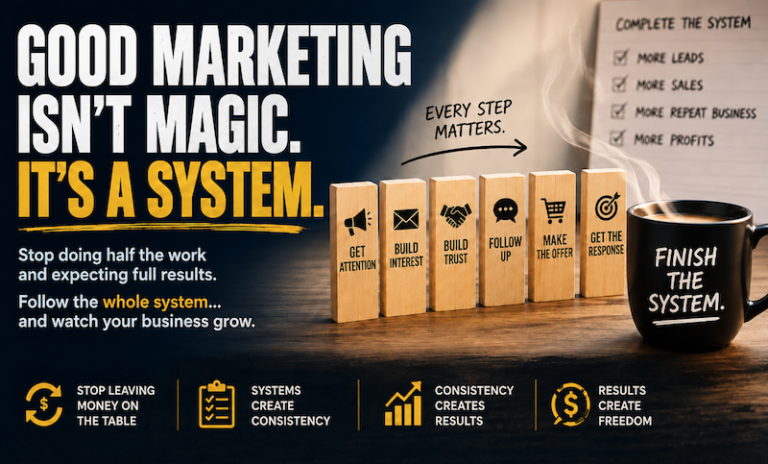
What you’ve just seen is one piece of a larger system designed to turn one customer into multiple without chasing, discounting, or constantly starting over. That system is what separates the businesses that grow from the ones that stay stuck in cycles.

If you want to see how it works in the real world, go here:

https://mobilitymarketer.com

P.S. If you’re still chasing leads while ignoring the customers you already have, you’re making this harder than it needs to be.