Why Being “Good at What You Do” Is Quietly Sabotaging Your Business
Posted on by Dan Anderson
Why countless service business owners stay overworked, underpaid, and trapped in an endless cycle of chasing the next customer—even though they're excellent at what they do.
There's a belief that's been floating around the service business world for generations. It's repeated by well-meaning friends, proud craftsmen, and seasoned veterans alike. It sounds noble, responsible, and almost impossible to argue with. The advice usually goes something like this: Just do great work and the customers will come. It feels comforting because it suggests that quality alone is enough to build a thriving business. Unfortunately, the marketplace doesn't reward comforting beliefs. It rewards results. And that's where this popular advice quietly falls apart.
Don't misunderstand me. I'm not suggesting you lower your standards or stop caring about your workmanship. Quite the opposite. The quality of your work is the foundation of everything else you build. Without it, your reputation eventually collapses. But quality, by itself, isn't a marketing strategy. It's simply the admission ticket that allows you to stay in business once customers actually decide to hire you.
The painful truth is this: customers can't appreciate work they've never experienced. They buy based on what they believe before they ever see what you can do.
Every town has an outstanding technician nobody talks about. He's meticulous. He's honest. He arrives when he says he will. He treats every customer's property with respect. His workmanship is nearly flawless. Yet every few weeks he's staring at an empty calendar wondering why the phone has gone silent. Meanwhile, another company across town—with work that's merely good enough—is booked solid for the next three weeks. They aren't necessarily more talented. They're simply more memorable.
That's because the marketplace doesn't reward effort. It doesn't hand out trophies for craftsmanship. Customers don't compare every service provider side by side before making a decision. They don't inspect your technique with a clipboard and scorecard. Instead, they make incredibly fast decisions based on familiarity, trust, confidence, and memory. By the time your workmanship finally has an opportunity to impress someone, you've already won—or lost—the sale.
Think about your own buying habits for a moment. When your air conditioner quits working in the middle of July, do you immediately begin conducting a detailed investigation into every HVAC company within fifty miles? Probably not. You call the company whose name you remember. The one you've seen around town. The one that mailed you something useful. The one that followed up after your last service call. The one that somehow stayed in front of you while everyone else quietly disappeared.
Customers don't hire the business they forgot.
That's the part many service business owners never fully appreciate. They assume that because customers were thrilled with the finished job, they'll naturally remember who did it months or even years later. Unfortunately, life doesn't work that way. Your customer isn't trying to forget you. They're simply busy living their own life. They're raising children, working overtime, paying bills, coaching Little League, worrying about college tuition, planning vacations, replacing appliances, and trying to remember why they walked into the garage fifteen minutes ago. You may have been the highlight of your own workday, but to them you were one event among thousands.
That's why depending on memory is such a dangerous business strategy. Every day that passes after you've completed a job, your customer is exposed to more advertisements, more competitors, more trucks driving through the neighborhood, more postcards, more social media posts, and more conversations about businesses that aren't yours. Unless you've intentionally built a system that keeps your name in front of them, you're slowly fading into the background. Not because your work wasn't excellent—but because human memory naturally fades.
One of the biggest myths in small business is the belief that word-of-mouth will eventually solve everything. Word-of-mouth is wonderful. Referral business is wonderful. Repeat customers are wonderful. But none of those things happen automatically forever. They have to be encouraged, nurtured, and strengthened. Hope isn't a marketing strategy. Neither is sitting back and assuming satisfied customers will somehow become your unpaid sales force for the next twenty years.
There's another dangerous consequence of relying entirely on quality. It slowly convinces business owners that marketing isn't necessary. They begin believing that advertising is for businesses with inferior products. They secretly assume that if they just keep improving their technical skills, customers will eventually notice. So they buy another tool. Attend another certification class. Invest in another piece of equipment. Meanwhile, their competitors are investing in visibility, positioning, customer follow-up, referral systems, newsletters, email marketing, direct mail, and relationship building.
Guess which business customers remember first?
The irony is almost painful. The owner who's constantly improving his technical skills often becomes easier to overlook because he spends almost no time improving his marketing. He has unknowingly built a business that's dependent upon customers remembering him on their own. That's a risky bet because people are remarkably good at forgetting businesses they genuinely liked.
Quality earns satisfaction. Marketing earns remembrance.
Imagine two painters who both complete outstanding work. One shakes hands, collects payment, thanks the customer, and disappears until the next estimate request finally arrives. The other completes the exact same quality of work but follows up with a thank-you note, sends helpful homeowner maintenance tips throughout the year, checks in before repainting season begins, asks for referrals at the appropriate time, and stays visible without becoming annoying. Which painter is more likely to receive the next call? It isn't because one painted better. It's because one intentionally stayed remembered.
That's the difference between hoping your business grows and designing it to grow.
The smartest service businesses understand that every completed job should begin a long-term relationship rather than end one. They know that today's customer is tomorrow's repeat customer, referral source, online review, testimonial, neighborhood influence, and lifetime value. They refuse to treat the final invoice as the finish line. Instead, they see it as the beginning of a customer relationship worth protecting.
This way of thinking changes everything. Instead of constantly worrying about where the next customer will come from, you begin asking how to maximize the value of every customer you've already earned. Instead of chasing strangers every month, you start building relationships that produce business year after year. Instead of depending on expensive advertising to replace customers you've forgotten, you create systems that prevent being forgotten in the first place.
That's where real control begins.
It also changes how you look at marketing itself. Marketing isn't something you do because your business is struggling. Marketing is what prevents your business from struggling in the first place. It's the system that quietly keeps your name alive while you're busy serving existing customers. It's the bridge between one completed job and the next opportunity.
The businesses growing the fastest today aren't always the ones doing the very best work. They're the ones making it easiest for customers to remember them, trust them, and choose them again. They're combining quality with visibility. Excellence with follow-up. Great workmanship with consistent communication.
Being great at your craft is admirable. Being remembered for your craft is profitable.
Imagine opening your calendar and seeing repeat customers already scheduled before you've spent a dollar chasing strangers. Imagine referrals arriving because you've intentionally built a process that encourages them instead of merely hoping they'll happen. Imagine customers calling you first because your business has remained familiar long after the original work was completed. That's not fantasy. It's what happens when marketing supports quality instead of replacing it.
The service business owner who understands this stops thinking like a technician who occasionally advertises and starts thinking like a marketer who happens to perform outstanding work. That's a subtle shift in thinking, but it changes nearly every decision the business owner makes going forward.
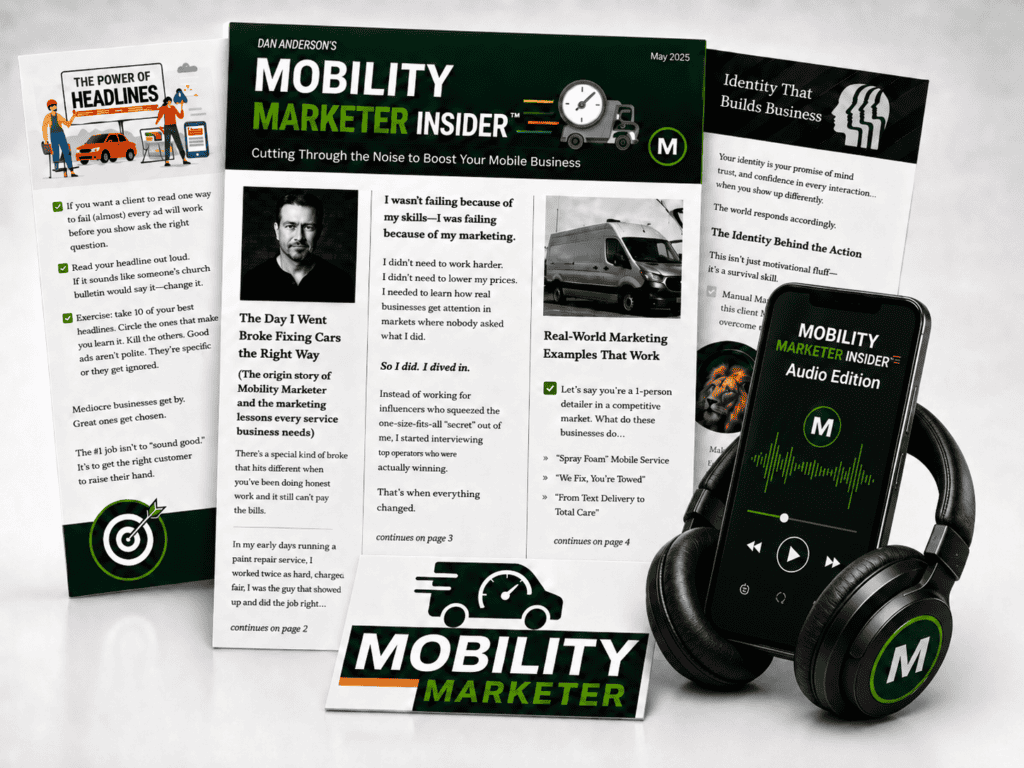
Get the Free Special Edition of Mobility Marketer Insider™ + Audio
If this article challenged the way you've been thinking about your business, then you're exactly the type of owner I created Mobility Marketer Insider™ for.
This isn't another collection of motivational slogans, trendy social media tricks, or complicated theories written by people who've never loaded a truck, met a customer in a driveway, or depended on a service business to pay the mortgage. It's built for operators who still do the work every day but want smarter, more predictable ways to grow their businesses.
Inside the FREE Special Edition, you'll discover practical marketing strategies designed specifically for service businesses—strategies for generating more repeat customers, staying in front of past clients, increasing referrals, creating stronger offers, building memorable customer experiences, and developing marketing systems that continue producing results long after today's job is finished.
Better yet, you'll also receive the complete audio edition, allowing you to turn drive time into learning time. Listen while traveling between appointments, loading equipment, organizing the shop, or handling the countless responsibilities that come with running a service business. Instead of losing valuable hours behind the wheel, you'll be building marketing knowledge that compounds every time you apply it.
Thousands of service business owners spend decades mastering their craft. Very few ever master the marketing strategies that consistently keep customers coming back. Those who learn both almost always become the businesses everyone else wonders about.
Get your FREE Special Edition of Mobility Marketer Insider™, including the complete audio edition, today at:
Read it. Listen to it. Then start building a business that's remembered long after the work is finished.