The Statement That Makes Customers Choose You Before They Shop You
Posted on by Dan Anderson
A service business without a clear reason to choose it gets thrown into the same ugly pile as every other quality, affordable, family-owned company begging to be compared by price.
Service businesses don't lose customers because they are bad at the work.
That would be too easy. If bad work were the only problem, the cure would be simple: stop doing bad work. Put down the duct tape. Quit using the bargain-bin equipment that sounds like a leaf blower with asthma. Learn the trade. Do what you promised. There, fixed.
But that is not where most decent service businesses are losing money.
They are losing money because the customer cannot tell why they should choose them over everybody else who looks, sounds, smells, and advertises exactly the same.
That is a much uglier problem.
Because when the customer cannot see a meaningful difference, he does what customers naturally do. He shops price. He delays. He compares. He asks three companies for estimates. He says he will get back to you, which is customer language for I am now wandering into the swamp and may never be seen again.
This is why every service business owner needs a Competitive Edge Statement.
Not a slogan. Not a cute tagline. Not some decorative sentence invented by a graphic designer after drinking a latte with foam art shaped like a nervous swan.
A Competitive Edge Statement is a precise, useful, memorable explanation of why a customer should choose you instead of anyone else.
It answers the question sitting silently in the customer’s mind:
Why should I do business with you instead of your competitors?
That question is always there.
The customer may not say it out loud. He may smile, nod, look at your website, pretend to read your About page, and tell you everything looks good. But underneath the polite surface, his buying brain is holding court like a suspicious old judge in a black robe.
Why you?
Why not the cheaper guy?
Why not the bigger company?
Why not the company with more reviews?
Why not wait until next month?
Why not ignore the problem altogether and hope it magically fixes itself, which is still the most popular repair strategy in America?
Your Competitive Edge Statement exists to answer that question before the customer escapes.
A weak business says, We provide quality service at affordable prices.
Congratulations. So does everybody else, including the guy operating out of a faded van with one hubcap and a voicemail greeting from 2017.
Quality service is not a Competitive Edge Statement. Affordable prices is not a Competitive Edge Statement. Family owned is not enough. Licensed and insured is not enough. Friendly and professional is not enough. Those things may help, but they do not separate you. They are expected.
Nobody hires a carpet cleaner and says, I was going to choose the guy who seemed openly hostile and uninsured, but then I found this company that claims to be professional.
That is not persuasion. That is table stakes.
Your customer is looking for a reason to feel safe choosing you. He wants relief from uncertainty. He wants to believe he is making a smart decision. He wants to avoid embarrassment, regret, wasted money, and the sick little feeling that comes from hiring the wrong person and then having to explain it to his wife, husband, boss, tenant, neighbor, or mother-in-law, depending on who is holding the emotional grenade.
A strong Competitive Edge Statement gives him that reason.
One of the cleanest examples in business history came from a pizza company. The promise was simple: fresh, hot pizza delivered fast, with a specific time guarantee. It did not brag about old-world sauce. It did not claim to have the most authentic cheese experience this side of Naples. It did not try to sound like a chef whispering to tomatoes under moonlight.
It found the opportunity gap.
People wanted pizza delivered quickly. Nobody owned speed in the customer’s mind. So the company grabbed that space and drove a truck through it.
That is the lesson.
A strong Competitive Edge Statement does not try to say everything. It says the one thing that matters enough to move the customer.
This is where service business owners get themselves into trouble. They want to include everything.
We are reliable, affordable, professional, friendly, experienced, local, honest, family owned, customer-focused, detail-oriented, fully insured, and committed to excellence.
That is not a message. That is a junk drawer.
The customer cannot carry all that around in his head. Worse, he does not believe half of it because every business says some version of the same tired parade.
You do not need to tell the customer everything. You need to tell him the thing that makes choosing you easier.
The right Competitive Edge Statement usually comes from one of several places.
It may come from speed. Maybe the customer hates waiting. Maybe the industry is notorious for vague arrival windows, late callbacks, slow scheduling, or providers who act like showing up is a generous favor. In that market, speed is not merely convenience. It is relief.
It may come from certainty. Customers hate mystery. They hate unclear pricing, vague timelines, hidden charges, and being told we’ll see once we get there. A business that reduces uncertainty becomes easier to trust.
It may come from specialization. The narrower and clearer your specialty, the easier it is for the customer to believe you are the safer choice. Generalists get compared. Specialists get remembered.
It may come from protection. Protection from damage. Protection from wasted money. Protection from surprise charges. Protection from making the wrong decision. Protection from the cheap shortcut that creates a bigger problem later.
Those are not the only sources, but they are common ones. And in service businesses, they are powerful because the customer is usually buying more than the finished job.
He is buying confidence.
He is buying relief.
He is buying the hope that this will not turn into one more aggravating little disaster that eats his time, his money, and his patience like a termite with a gym membership.
The sharper your advantage, the easier it is for the customer to repeat.
That matters.
A good Competitive Edge Statement should be simple enough for a satisfied customer to say to somebody else.
Use him. He fixed it in two hours and avoided an insurance claim.
Call her. She gives exact pricing before she starts, so there are no surprises.
You need this company. They specialize in pet odor, not just surface cleaning.
That is marketing gold. Not because it sounds clever, but because it travels.
A message that cannot be repeated cannot spread.
Many service business owners accidentally hide their strongest selling point because they think it is obvious. It is not obvious. Nothing is obvious to the customer. The customer does not live in your business. He does not know your process. He does not know why your method is better. He does not know what mistakes bad providers make. He does not know what questions to ask.
He only knows he has a problem and does not want to feel stupid after hiring someone.
Your job is to educate him just enough to make your advantage matter.
For example, a mobile repair business may know that avoiding an insurance claim or public damage record is a major advantage. The customer may not. So the statement has to say it clearly, often, and without apology.
A carpet cleaner may know that deep odor removal is different from ordinary surface cleaning. The homeowner may not. So the message has to separate real problem-solving from just making carpet look damp and temporarily hopeful.
A pressure washing company may know that the wrong method can damage surfaces. The homeowner may not. So the advantage may be safety, control, and the removal of ugliness without creating a new repair bill.
That is enough.
You do not need twenty examples. You need the reader to recognize the pattern and feel the gap in his own business.
Do not assume the customer understands the value. Make the value impossible to miss.
There is another reason this matters.
Your Competitive Edge Statement disciplines your entire business.
That is the part most owners miss.
This is not just copywriting. This is not just a sentence for the website. This is a business decision. Once you claim an advantage, you have to build the business to support it.
You cannot claim speed and then wander into appointments like a sleepy raccoon.
You cannot claim premium service and then communicate like a teenager avoiding chores.
You cannot claim no surprises and then ambush the customer with extra charges after the job starts.
You cannot claim expertise and then use vague, weak language that sounds copied from every competitor’s homepage.
Your Competitive Edge Statement becomes a standard. It tells the market what to expect, and it tells you what you must deliver.
That is why you do not rush it.
You find it by listening.
Ask your best customers why they chose you. Ask what they appreciated most. Ask what they were worried about before hiring you. Ask what irritated them about past providers. Ask what they wish companies in your category would do better.
Do not merely ask what they liked. That usually gets polite nonsense.
Ask what nearly stopped them from buying. Ask what made them trust you. Ask what they would tell a friend about you. Ask what they were relieved about after the job was done.
The money is often hiding in the relief.
Customers may not say, I selected your firm because your operational excellence created a differentiated buying environment.
They will say, I liked that you called me back.
They will say, I liked knowing the price before you came out.
They will say, I liked that you explained what could and could not be fixed.
They will say, I liked that you did not make me feel dumb.
They will say, I liked that you showed up on time.
There it is. Raw material.
The owner then has to turn that raw material into a clean, compelling Competitive Edge Statement.
Not a paragraph.
Not a slogan trying to win a beauty contest.
Not a corporate mission statement written by someone trapped in a conference room with bottled water and no escape route.
A short, sharp statement.
One to three sentences.
Clear benefit.
Clear difference.
Clear reason to choose.
It should say what you do in a way that makes the right customer lean forward instead of drifting away.
Here is the danger: most owners want the statement to sound impressive. That is the wrong goal.
The goal is not to impress the customer.
The goal is to make the customer think, That is exactly what I need.
That is a very different assignment.
Impressive language often gets vague. Useful language gets specific.
Impressive language says, We are committed to excellence.
Useful language says, You will know the price, the arrival window, and the repair limits before you waste time or money.
Impressive language says, We care about quality.
Useful language says, We remove the odor source, not just the smell on top.
Impressive language says, We are your trusted local experts.
Useful language says, We fix minor bumper damage in two hours or less without an insurance claim.
The customer does not reward you for sounding polished. He rewards you for making his decision easier.
Categories get compared. Advantages get chosen.
Once you have your Competitive Edge Statement, use it everywhere.
Put it on your website homepage. Put it near your estimate form. Put it on your business card. Put it in your email signature. Say it when someone asks what you do. Use it in your ads. Use it in your follow-up. Train anyone answering the phone to understand it.
The worst thing you can do is create a strong statement and then bury it like a family secret.
Your Competitive Edge Statement should become the drumbeat of your business.
Repetition is not the enemy. Confusion is the enemy.
Customers are busy. Distracted. Overloaded. Mentally assaulted by messages all day long. They are not studying your brand with a pipe and a leather chair. They are skimming. Clicking. Comparing. Half-listening. Thinking about dinner. Wondering why the dog is limping. Trying to remember whether they paid the power bill.
So you repeat the advantage until it sticks.
Not obnoxiously. Not like a carnival barker with a discount banner and a personality disorder. But consistently enough that the customer begins to associate your business with the benefit you want to own.
Speed.
Certainty.
Specialization.
Protection.
Convenience.
No mess.
No waiting.
No pressure.
No cheap shortcuts.
Whatever it is, make it yours.
A service business without a Competitive Edge Statement is forced to fight in the mud pit of sameness. That is where price shoppers live. That is where weak leads gather. That is where owners complain about cheap competitors while sounding exactly like them.
A service business with a strong Competitive Edge Statement climbs out of that pit.
It gives the customer a reason.
It gives your ads a backbone.
It gives your website a spine.
It gives your sales conversations direction.
It gives your referrals language.
It gives your business a sharper identity than We do good work and hope somebody notices.
Hope is not a marketing strategy. It is a nice emotion for greeting cards and lottery tickets.
Your customer needs a reason to choose you.
Give him one.
Then say it clearly, say it often, and make sure the business delivers on it so well that your customers start saying it for you.
That is when your marketing stops begging for attention and starts building preference.
And preference is where the money is.
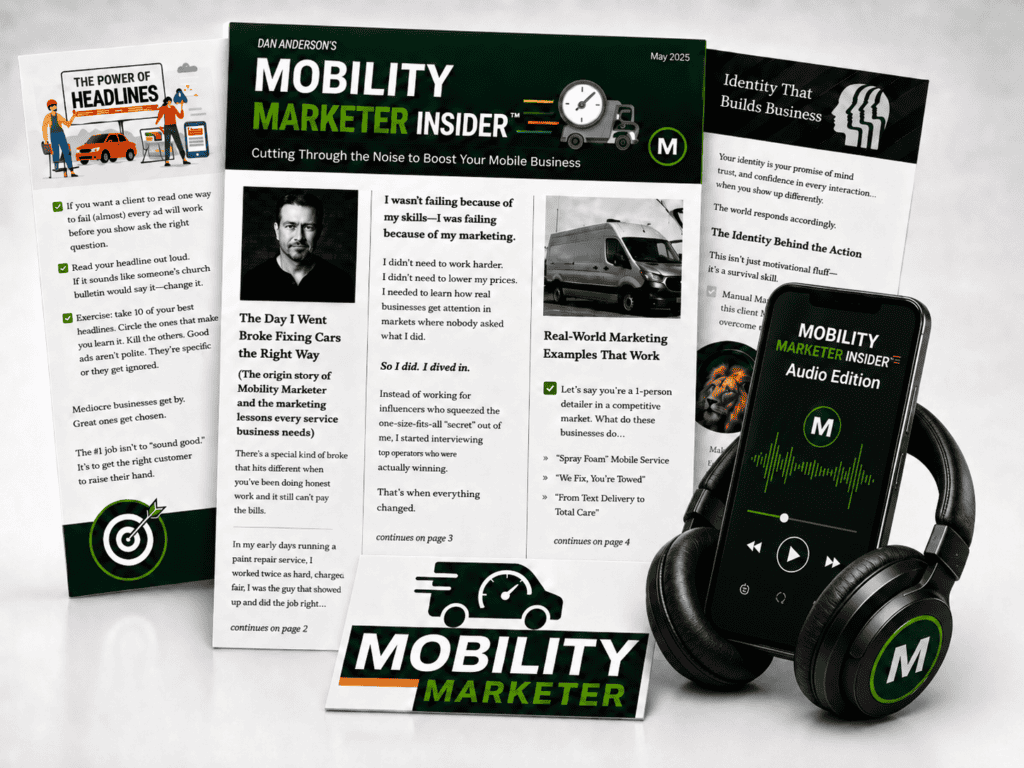
Mobility Marketer Insider™
For more practical marketing ideas written for service business owners who are tired of blending in with every other nice, professional, affordable, family-owned company in town, subscribe to Mobility Marketer Insider™ at mobilitymarketer.com.
mobilitymarketer.comEach issue gives you usable strategies, examples, templates, and tools to help you sharpen your message, attract better customers, and stop letting weaker competitors win just because they managed to sound exactly like you first.