Why Pretty Ads Don’t Pay the Bills
Posted on by Dan Anderson
The right ads are built to make the phone ring, create action, and prove whether your marketing money is working or quietly escaping through the back door.
Are you under-advertised or rather badly advertised?
There is a difference. A painful, expensive, wallet-emptying difference. The average service business owner is not failing because he forgot to tell the world he exists. He is failing because he is spending money on messages that do not demand response, do not make an offer, do not give a reason to act now, and cannot be tracked without hiring a mind-reader with a calculator.
This is why every serious service business owner needs to learn direct response marketing. Not someday. Not after the logo is perfect. Not after the website has been massaged, moisturized, and professionally photographed like a catalog model with trust issues. Now.
Direct response marketing is advertising built to make a prospect take action. It is not there to decorate the marketplace. It is not there to make the owner feel important. It is not there to win applause from other business owners who are also broke but have very attractive business cards. It exists to create response.
A direct response ad has certain required parts. It has a headline that grabs attention. It creates interest in the service or product. It builds desire in the prospect by connecting the offer to something he already wants, fears, hates, or is embarrassed by. It presents a specific offer. And it gives a deadline, cutoff date, or reason to respond now.
That last part matters because people delay. Human beings are professional delay machines. They can postpone a buying decision longer than a government committee can postpone responsibility. They see your ad, nod their head, think they should do something, then immediately get distracted by lunch, a text message, a barking dog, or some little glowing rectangle feeding them videos of people falling off ladders.
So your advertising must not merely inform. It must move them.
Most advertising does not do that. Most advertising says the name of the business, shows the logo, lists a few services, and tosses in dead phrases like quality work, affordable pricing, family owned, trusted service, and satisfaction guaranteed. Then the owner waits. The phone does not ring. The inbox does not fill. The calendar does not improve. Somewhere, an advertising salesperson is already preparing the next excuse.
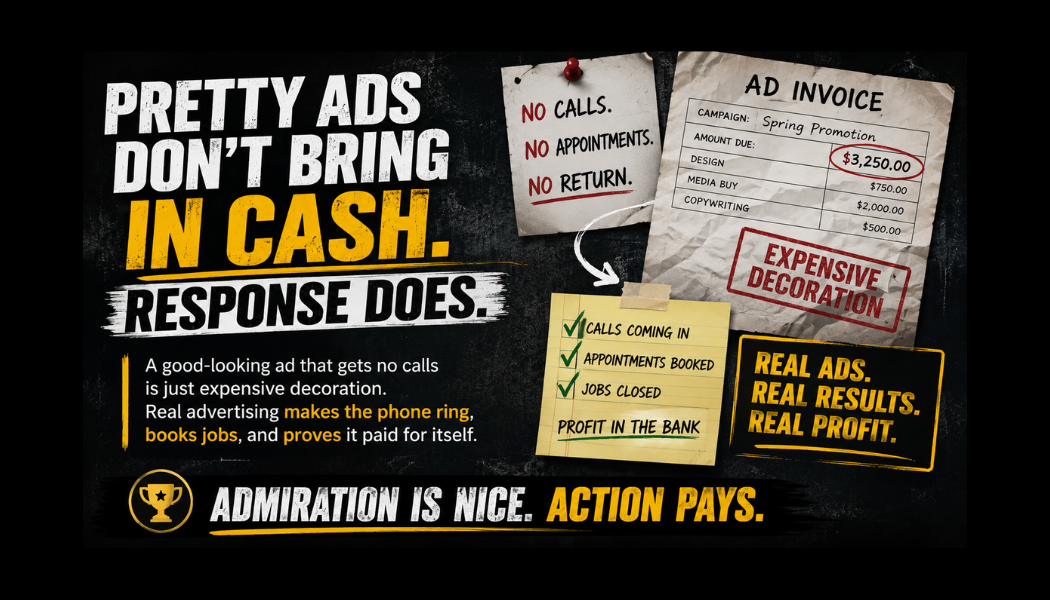
This kind of advertising is usually called institutional advertising or image advertising. That is a polite name for advertising that cannot be held accountable without causing embarrassment at the next meeting. There is no specific offer. No direct call to action. No reason to respond today. No clean way to know whether the ad made money or simply left the building dressed as a business expense.
And this is exactly why many advertising agencies love it.
When an institutional ad fails, nobody has to stand in front of the owner and say, We produced a dud. Instead, they blame the economy. They blame the market. They blame consumer confidence. They blame timing. They blame the phase of the moon and the emotional condition of the average homeowner’s garage door.
Then comes the really dangerous excuse: the public just needs to see the ad more often.
That little sentence has stolen a lot of money from small business owners.
The theory goes like this: the ad did not work because people have not seen it enough. Run it again. Then again. Then again. Eventually, after enough repetition, the prospect will awaken from his consumer coma, remember your clever little slogan, and stampede toward your business waving cash.
Sometimes repetition helps a good message work better. But repetition does not turn a dead ad into a money machine. It just gives the corpse more exposure.
A bad ad repeated ten times is not branding. It is a slow leak in your bank account wearing a nice shirt.
There is a tiny amount of truth in the repetition argument. Some response may come from people who saw your message before. But that is the frosting on the cake. The problem is, many service business owners have no cake. They are serving frosting on a paper plate and calling it dinner.
Big companies can get away with this kind of waste for a while. McDonald’s, Budweiser, Domino’s, and giant national brands can pour money into name recognition because they have massive budgets, massive distribution, and enough market presence to survive stupidity that would kill a local operator by Thursday.
A small service business cannot afford that luxury.
A carpet cleaner, pressure washer, detailer, window washer, landscaper, painter, handyman, or mobile service owner needs advertising that does something now. Not awareness in twelve months. Not maybe someday. Not brand warmth. He needs calls, appointments, estimates, booked jobs, referrals, returning customers, and cash.
That is the only reason to advertise.
Advertising is supposed to get more clients.
Not compliments. Not awards. Not design approval. Not comments from relatives who think everything you do is wonderful because they remember when you had braces and a bicycle.
Clients. Cash. Response.
That is the point.
Direct response marketing forces discipline onto your advertising. It makes you stop hiding behind vague language and start making measurable offers. It makes you stop saying, We provide professional service, and start saying something the prospect can actually feel.
A weak carpet cleaning ad says, We offer quality carpet cleaning at affordable prices.
A direct response carpet cleaning ad says, Pet odor still hanging around after you cleaned the carpet? Schedule by Friday and get $50 off a deep extraction cleaning for problem rooms.
One describes the business. The other enters the prospect’s life.
A weak pressure washing ad says, Residential and commercial pressure washing.
A direct response pressure washing ad says, Green siding making your house look abandoned? Book your wash by May 31 and get the front walkway cleaned at no extra charge.
One sits there. The other points at an irritation and offers relief.
That is what good advertising does. It does not merely announce your existence. It identifies a problem the prospect already has, intensifies the cost of ignoring it, presents your service as the way out, and gives him a reason to move before his lazy little decision-making mechanism rolls over and goes back to sleep.
Service business owners also need to hear this: never fall in love with your ad.
This is where many owners get into trouble. They write an ad or pay someone to design one, and then they become emotionally attached to it. They like the colors. They like the layout. Their spouse likes it. Their friend says it looks professional. The designer says it has strong visual balance, which is usually designer language for it may not sell, but it will look lovely while failing.
None of that matters.
An ad is not good because you like it. An ad is good because it produces profitable response.
That is the test.
Did the phone ring? Did people click? Did they request estimates? Did they book? Did they buy? Did the ad bring back more money than it cost?
That is the scoreboard.
A plain, ugly, old-fashioned ad that brings in profitable jobs is a beautiful thing. A gorgeous ad that brings in silence is just expensive wall art for your marketing graveyard.
So here are the rules every service business owner should nail to the wall before buying another ad.
Never run anything you cannot track.
Never keep repeating an ad that failed just because someone tells you people need to see it more often.
Never fall in love with your own marketing until the numbers prove it deserves affection.
And most of all, become a student of direct response marketing. Not because it is trendy. It is not. Not because it is fashionable. It is usually the opposite of fashionable. Direct response often looks too direct, too obvious, too sales-driven, too plain, too aggressive for people who would rather be admired than paid.
That is exactly why it works.
Your competitors are mostly trapped in the fog. They are running ads that say the same thing every other service business says. They are trying to sound safe, polished, professional, and harmless. They are hiding behind logos, service lists, vague promises, and dead little slogans that could be swapped with any competitor in town without anyone noticing.
You do not have to play that game.
You can make offers. You can create urgency. You can track response. You can write headlines that call out real problems. You can speak to the customer’s embarrassment, frustration, desire, irritation, and private motivation. You can give clear instructions. You can make your marketing work like a salesman instead of a sleepy brochure wearing cologne.
That is direct response.
And for a service business owner who wants better clients, better cash flow, and less dependence on random hope, it is not optional. It is the difference between buying advertising and buying results.
Mobility Marketer Insider™
For more practical, field-tested marketing ideas written specifically for service business owners, subscribe to Mobility Marketer Insider™ at mobilitymarketer.com.
mobilitymarketer.comEach issue gives you usable strategies, examples, templates, and tools to help you attract better clients, sharpen your offers, improve follow-up, and stop wasting money on advertising that looks pretty while your calendar sits there like a lonely diner at closing time.