The $29 Ad That Can Cost You a Customer for Life
Posted on by Dan Anderson
Why winning the first call with a bargain price can quietly cost you repeat business, referrals, and years of customer value.
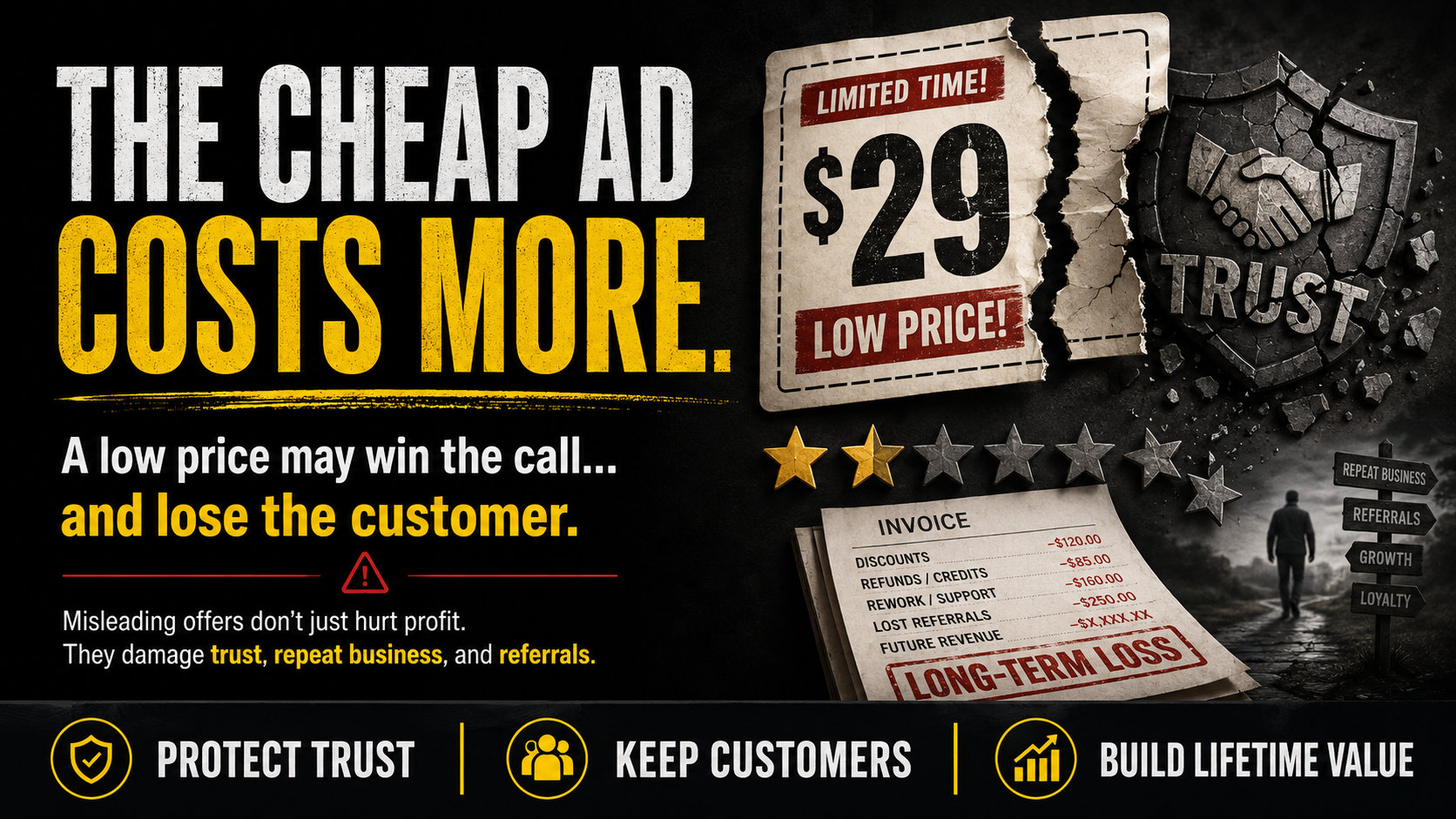
There’s a dangerous little marketing temptation hiding in plain sight. It usually arrives wearing a giant price tag, a bright color, and the promise of instant phone calls. The strategy sounds simple enough: advertise an unusually low price, get the customer to respond, get yourself in front of them, and then sell them the service they actually need once you’re there. On a spreadsheet, this can look clever. In the real world, it can quietly destroy something far more valuable than the profit on a single job: the customer’s trust.
The problem isn’t offering a low price. The problem isn’t upselling. The problem isn’t giving customers several service levels. All of those can be perfectly good marketing strategies when they’re handled honestly. The problem begins when your advertised offer creates one expectation while your sales process depends on replacing that expectation with another. The customer thinks they’re buying one thing. You already know they’re probably going to need something much more expensive. That gap between what they expected and what they’re eventually asked to pay is where the trouble begins.
And once that gap becomes visible, the customer stops listening to your explanation and starts wondering what else they shouldn’t trust.
The Low Price Gets the Call—but It Also Chooses the Customer
There’s a reason low-price advertising refuses to disappear. It gets attention. Put “Whole House Cleaning — $49” beside “Professional Carpet Cleaning Services Available” and the $49 offer is going to get noticed. Put “Driveway Cleaning — $79” next to “Exterior Surface Cleaning Services” and the cheap price will usually win the first glance.
But getting attention and getting a profitable customer aren’t the same thing.
The advertisement doesn’t merely attract people. It filters them. Whatever you emphasize in your marketing determines the type of prospect who raises their hand. If your entire message revolves around the lowest possible price, you’re going to attract a heavier concentration of people who make decisions primarily on price.
That means the very thing you used to get more calls can become the thing that makes those calls harder to convert profitably.
Marketing selects your customers before you ever speak to them.
If your message says cheap, cheap, cheap, the prospect who responds may arrive expecting cheap from beginning to end. The moment you ask them to move from a $49 expectation to a $249 reality, you aren’t simply changing the price. You’re changing the agreement they believed existed.
The Customer Has Already Made a Deal With You in Their Mind
When someone responds to an advertised price, a psychological agreement has already been formed.
They saw $49.
They pictured spending roughly $49.
They called because of $49.
Then you arrive and explain that the advertised service doesn’t include the things required to actually solve the problem properly. Suddenly the real job costs several times more.
You may have technically disclosed the limitations. The advertisement may even contain enough fine print to satisfy every attorney in the county. None of that changes the customer’s emotional reaction.
If the customer feels tricked, you’ve already lost something important.
That doesn’t necessarily mean you lose the job. Some customers will still authorize the work. But you may have lost the relationship.
That distinction matters because the customer’s perception becomes part of your marketing whether you intended it or not. People don’t judge a business based only on what the advertisement legally said. They judge the business based on what they believed they were being promised.
Good marketing makes the promise easier to understand. Bad marketing forces the customer to reinterpret it after they’ve already responded.
Upselling Isn’t the Problem
Upselling is valuable when it improves the customer’s outcome.
A mobile detailer notices severely oxidized headlights and offers restoration while already onsite. A pressure washer finishes the driveway and points out that the patio can be cleaned while the equipment is already set up. A cleaner recommends stain protection after completing the service. There’s nothing inherently wrong with any of that.
The customer received what was originally promised. The additional service is genuinely additional.
That is an upsell.
The problem begins when the advertised service is so stripped down that the customer practically has to upgrade just to receive the result they believed they were buying in the first place.
That is where trust starts leaking out of the transaction.
There is an enormous difference between:
“You received exactly what we promised. Here’s another option you may benefit from.”
and:
“The price you responded to won’t really solve your problem, so here’s what you actually need.”
One strengthens the relationship. The other makes the customer wonder why you didn’t simply tell them that before they called.
You Can Win the Sale and Still Lose the Customer
This is the part that doesn’t show up immediately in the advertising report.
Imagine the low-price campaign succeeds. The phone rings. Appointments get booked. Trucks stay busy. Revenue rises. Everybody celebrates because the advertisement appears to be working.
But what happens six months later?
Customers who felt pressured don’t come back. Customers who believed the advertised price was misleading don’t refer their neighbors. Some leave reviews warning other people about the pricing experience. Employees get tired of explaining why the advertised number and the actual invoice are so far apart.
The business keeps generating transactions, but it isn’t accumulating customers.
That is a very expensive distinction.
Repeat business, referrals, reactivation, and customer lifetime value depend heavily on trust.
If every completed job requires you to replace the customer with a brand-new stranger, your marketing machine has to run constantly just to keep the business standing still.
A healthy service business should become easier to market as the customer base grows because yesterday’s customers help create tomorrow’s revenue.
A weak customer experience prevents that compounding effect from ever developing.
The Real Value of the Customer Comes After the First Job
A service customer shouldn’t be viewed as a single invoice.
A satisfied customer may buy from you again next year. They may hire you for another service. They may recommend you to a relative, neighbor, coworker, or friend. They may respond when you send a seasonal offer six months from now. They may leave a review that convinces three other people to call.
That means the first transaction may be only a fraction of the customer’s actual value.
Now compare two very different statements being made about your company after the job is finished.
The first:
“They were great. Call them. I’ve used them before.”
The second:
“Watch the price. What they advertise isn’t what you end up paying.”
Both statements travel.
Only one builds your business.
That is why focusing exclusively on the cost of generating a lead can be dangerously shortsighted. A slightly more expensive customer who trusts you, returns, and refers others may be dramatically more valuable than several cheap leads attracted by a price that creates immediate suspicion.
You’re not merely acquiring jobs. You’re acquiring relationships that can produce future revenue.
Price Should Make the Offer Clearer, Not More Confusing
There’s nothing wrong with aggressive pricing when the price is genuine.
If you can legitimately perform the advertised service for $99, advertise $99.
If the service starts at $99 because every job is different, say that clearly and explain the variables.
If you have several service packages, show what each includes.
If certain conditions commonly increase the final price, tell the customer before the appointment.
Transparency doesn’t weaken a strong offer. Transparency can become part of the offer.
Consider the positioning opportunity created by an industry filled with questionable low-price advertising:
No $29 Gimmicks. No Surprise Charges After We Arrive. You’ll Know What the Job Costs Before We Start.
Now the conversation changes.
You’re no longer competing to see who can display the smallest number in the largest type.
You’re selling certainty.
And certainty has value.
A customer who has previously been burned by misleading pricing may actually be willing to pay more to avoid going through that experience again.
That’s how you stop fighting on price and start competing on confidence.
Sell the Outcome Instead of Worshipping the Price
Customers rarely wake up excited about buying a service category.
They want the result.
They want the carpet stain gone before guests arrive.
They want the driveway to stop looking neglected.
They want the damaged bumper repaired without surrendering the vehicle for several days.
They want the air conditioner working before the house becomes unbearable.
They want the leaking pipe fixed before the ceiling becomes part of the downstairs furniture.
The service is the mechanism. The outcome is what the customer actually wants.
When your marketing focuses on the outcome, price becomes only one part of the buying decision.
You can then compete on convenience, communication, expertise, reliability, speed, guarantees, reduced risk, cleanliness, professionalism, specialized methods, and the quality of the overall experience.
That gives you far more room to build a profitable business than a message built around “We’re cheaper.”
Because there will almost always be somebody willing to be cheaper.
There are far fewer competitors willing to become meaningfully better positioned.
Bad Pricing Advertising Creates Bad Conversations
There’s another hidden cost to misleading price advertising: what it does to the service experience itself.
When customers begin the appointment suspicious, the entire interaction becomes harder.
Instead of discussing the problem and the right solution, the conversation becomes a defense of the advertisement. The technician explains. The customer questions. The price gets justified. Somebody calls the office. Everyone starts the relationship with tension instead of confidence.
That isn’t good for the customer, and it isn’t good for the people representing your company.
A strong advertisement should make the sale easier before your employee ever arrives.
It should educate the prospect.
Set expectations.
Establish value.
Pre-frame the conversation.
And attract someone who already understands roughly what they’re buying.
The purpose of marketing isn’t simply to make the phone ring. It’s to make the right phone ring under the right circumstances.
That is a much higher standard.
It’s also a much more profitable one.
Would You Show the Advertisement to Your Best Customer?
Here’s a simple test.
Take your advertisement and imagine sitting across the table from your best long-term customer.
Show them the ad.
Then explain exactly what happens when someone responds.
Explain the price.
Explain the limitations.
Explain the likely upgrades.
Explain what the customer will probably end up paying.
Would you feel completely comfortable?
Would the customer say, “That’s fair”?
Or would you find yourself spending five minutes explaining why the offer isn’t quite what it appears to be?
That answer tells you something.
Good direct-response marketing should be strong. It should attract attention. It should create curiosity. It should give people a compelling reason to act. It should make an offer difficult to ignore.
But strong marketing doesn’t require broken expectations.
The best marketing makes a bold promise and then makes the business better at fulfilling it.
That is how trust becomes repeat business.
Repeat business becomes referrals.
Referrals lower your acquisition costs.
And eventually the business begins building on yesterday’s customers instead of replacing them every morning.
That is how you create something worth owning.
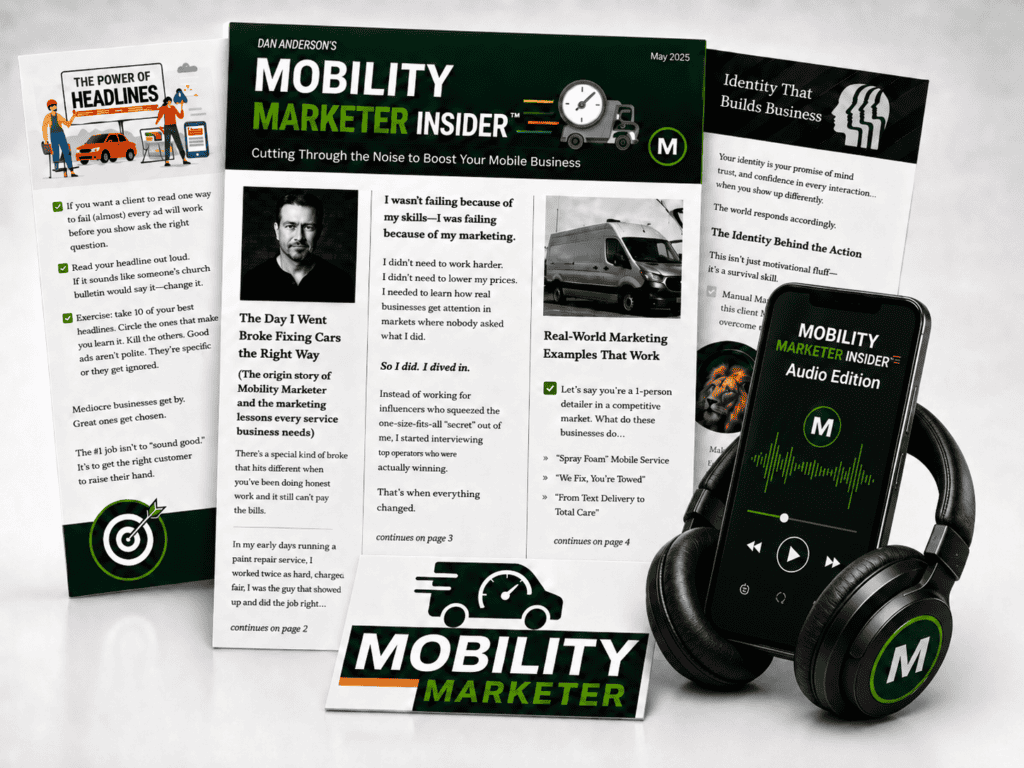
Get the FREE Special Edition of Mobility Marketer Insider™ + Audio Edition
If this article made you look at cheap-price advertising a little differently, there’s more waiting inside the FREE Special Edition of Mobility Marketer Insider™.
It was created specifically for service operators who want stronger offers, better customers, more repeat business, better follow-up, and marketing systems that produce measurable results instead of simply creating noise.
Inside, you’ll discover practical direct-response strategies for attracting customers without automatically racing competitors to the lowest price, keeping past customers from disappearing, generating more referrals, creating stronger positioning, and turning individual promotions into marketing assets you can continue using.
And because service operators aren’t sitting behind a desk all day, the Free Special Edition also includes the complete audio edition.
Listen while you drive between appointments, load equipment, work in the shop, or handle the daily demands of running the business.
Read it when you can. Listen while you work. Put the strategies to use.
Get the FREE Special Edition of Mobility Marketer Insider™ + Audio Edition at: