The Marketing Lesson You Forgot Is Probably Costing You Money Right Now
Posted on by Dan Anderson
Turn forgotten marketing strategies into business assets that keep producing customers, referrals, and profits long after the work is finished.
There’s a dangerous little lie hiding inside the head of every capable service professional.
It sounds reasonable. Responsible, even.
It's the statement, "I already know that."
You’ve read about follow-up. You’ve heard that headlines matter. You know testimonials help. You understand that customers need a reason to choose you instead of the other fellow with a truck, a phone, and a logo that looks like it was designed during a lunch break at the DMV.
So you nod, turn the page, close the browser, and go back to work.
Then six months later, your estimate form still has no follow-up sequence. Your advertisement still leads with the company name. Your website still says “quality service at affordable prices,” which is the marketing equivalent of announcing that your restaurant serves edible food. And the testimonial that could’ve helped close twenty jobs is still buried in an old email from a happy customer.
You knew the lesson.
You simply didn’t remember it at the moment when remembering could’ve made you money.
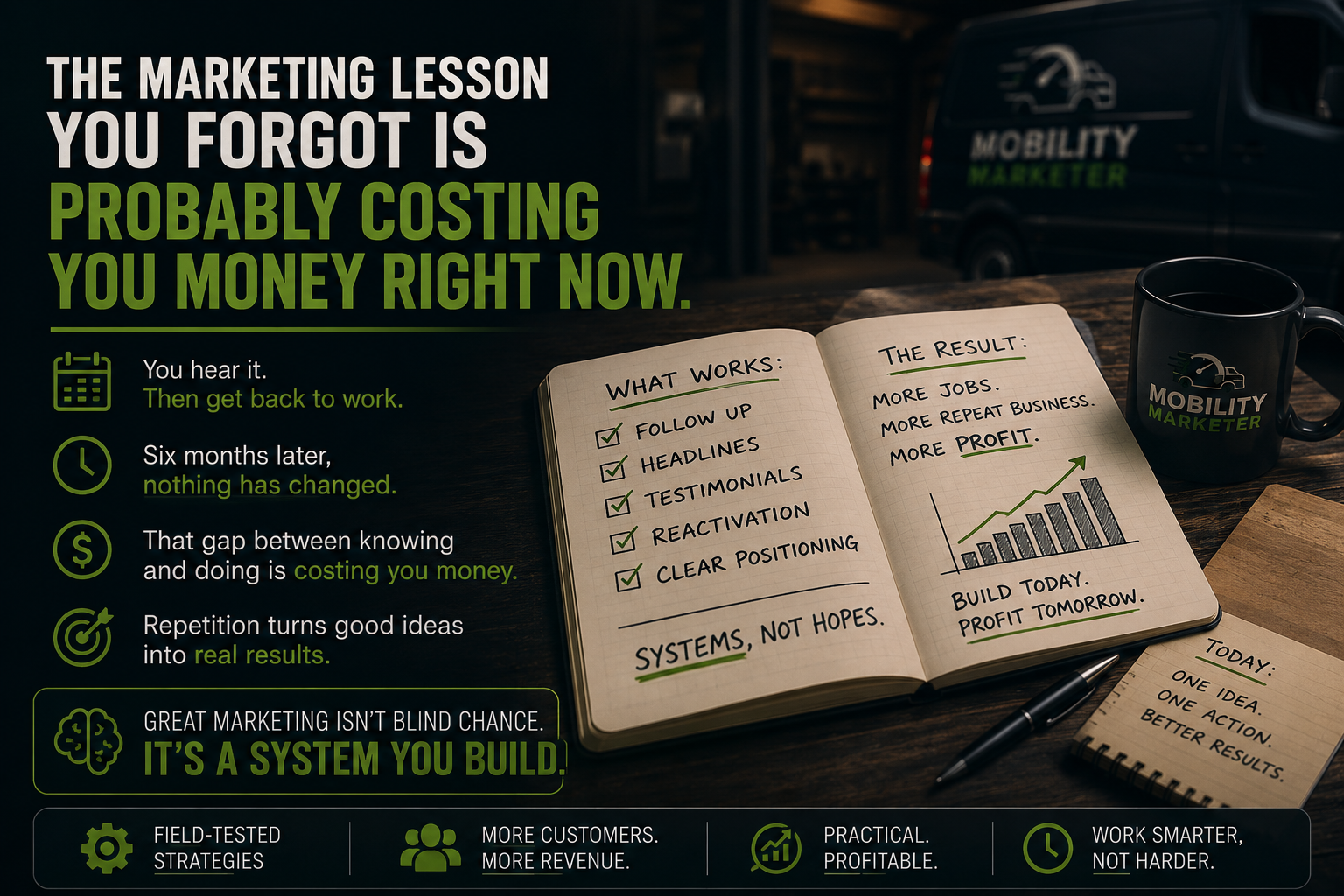
That’s the gap nobody warns you about. The distance between hearing a marketing idea and using it profitably can be wide enough to drive a fully wrapped service van through. Crossing that gap requires more than collecting information. It requires repetition, attention, and the discipline to return to good ideas until they become part of how you operate.
Your Memory Is Not a Filing Cabinet
People like to imagine the brain as a tidy office where information waits patiently in a labeled drawer. In reality, it’s more like the counter at a busy repair shop on Monday morning. A powerful marketing lesson can land there at 9:07 and be buried beneath a supplier problem by 9:12.
That doesn’t mean you’re careless or incapable. It means you’re human.
You can read a chapter today, agree with every word, and remember only a thin slice next week. Read it again three months later and an idea you barely noticed the first time may hit you between the eyes. The words didn’t change. You did.
Your current problems determine what your mind notices. When the schedule is full, a lesson about lead generation may seem mildly interesting. When the phone goes silent, that same lesson suddenly glows like an exit sign in a dark hallway. The ignored lesson about reactivation starts looking like buried treasure.
This is why one exposure isn’t enough. A good marketing idea often becomes valuable only after your circumstances catch up with it.
You’re in the Marketing Business, Whether You Applied for the Job or Not
A carpet cleaner may love restoring filthy carpet. A painter may take pride in a flawless finish. Fine. That’s the craft.
But the craft doesn’t ring the phone.
Before you can clean, paint, repair, install, inspect, wash, treat, trim, or restore anything, somebody must notice you. Then that person must believe you. Then that person must choose you. Then that person must act.
Every step in that chain is marketing.
You may perform a technical service, but you operate a marketing business that delivers that service. Ignore this distinction and you become dependent on blind chance, referrals that arrive when they feel like it, and platforms that can change the rules before breakfast.
Learning marketing isn’t a side hobby for rainy afternoons. It’s part of the owner’s job. Yet marketing is often treated like a vaccination: one dose should supposedly protect the company for life.
It doesn’t.
Customers change. Competitors copy. Advertising costs rise. Offers grow stale. Even timeless principles must be revisited because knowing that follow-up matters is quite different from having seven useful follow-up messages working while you sleep.
Repetition Isn’t Boring When It Pays
School trained people to think repetition is punishment. No wonder grown adults run from it as though it’s carrying a clipboard and assigning homework.
But profitable repetition isn’t mindless repetition.
It’s layered learning.
The first time you study an idea, you understand the concept. The second time, you notice the details. The third time, you connect it to a weakness in your company. The fourth time, you see how to apply it. The fifth time, you realize your first attempt was missing the piece that makes it work.
That’s why a strong book, newsletter, or audio program can become more valuable on the third pass. You’re returning because you now have better questions.
Imagine reading about a competitive edge statement before you’ve ever examined your competitors. You understand the definition, underline a sentence, and move on. Later, after looking at twelve competing websites that all promise “professional service,” “great customer care,” and “reasonable prices,” you return to the same lesson.
Now it stings.
You see the problem. Your message sounds exactly like theirs. You’re wearing a camouflage uniform in a parade and wondering why nobody can pick you out.
That second encounter creates action because experience has supplied the missing context. Repetition turns information into recognition. Recognition turns into application. Application can turn into revenue.
The Collection Trap
There is, however, another danger.
Some people don’t study marketing. They collect it. Their hard drive is a university. Their marketing still looks like a handwritten yard-sale sign.
Information alone doesn’t improve a company. Learning becomes profitable only when something changes: a headline, an offer, a follow-up message, a guarantee, a referral request, or the way value is explained.
The goal isn’t to consume more. The goal is to notice more, apply more, and retain more.
A simple learning rhythm can do that. Choose one meaningful lesson each week. Write down the idea with the greatest profit potential. Apply it to one real part of the business. Measure what happens. Then revisit it later with fresh eyes.
Speed creates the feeling of progress. Repetition creates command.
Turn Good Ideas Into Company Property
An idea hasn’t become part of your company merely because it passed through your head.
It becomes company property when it enters a system.
Your best headline should be saved where it can be tested. Your strongest testimonial should appear where buying decisions happen. Your follow-up sequence should run without depending on your memory. Lessons from failed promotions should be recorded so you don’t pay tuition for the same mistake twice.
This is the point where learning stops being inspiration and starts becoming an asset.
A trained mind notices opportunity. A documented system keeps it from escaping.
Systems remember when you don’t.
This is also why audio learning is useful. The drive between appointments can become a second encounter with an idea you first read days earlier. You hear a phrase differently. A weakness in your promotion comes to mind. The lesson moves from the page into the environment where you make business decisions.
Reading can introduce the idea. Audio can reinforce it. Application can lock it in.
The Compounding Return Nobody Sees at First
Marketing knowledge rarely produces its full return in one dramatic moment. It compounds.
One improved headline brings more readers into an advertisement. A clearer offer gets more of them to respond. Better follow-up converts people who weren’t ready on day one. A reactivation message brings old customers back. Suddenly, modest improvements are feeding one another.
From the outside, it can look as though the company discovered a secret lever.
It didn’t.
It built a smarter chain.
This is why learning matters even when business is good. A full schedule can hide weak systems. Then the market tightens, a competitor becomes aggressive, or a platform raises its price, and the hidden weakness sends an invoice.
The best time to strengthen your marketing mind is before desperation makes every idea look brilliant.
Desperate owners chase tricks. Prepared owners recognize principles.
One group asks, “What can I post today to make the phone ring by dinner?” The other asks, “What message, offer, follow-up system, and customer path can I build so next month isn’t held hostage by today?”
That difference doesn’t come from talent. It comes from repeated exposure to sound marketing thinking until better questions become automatic.
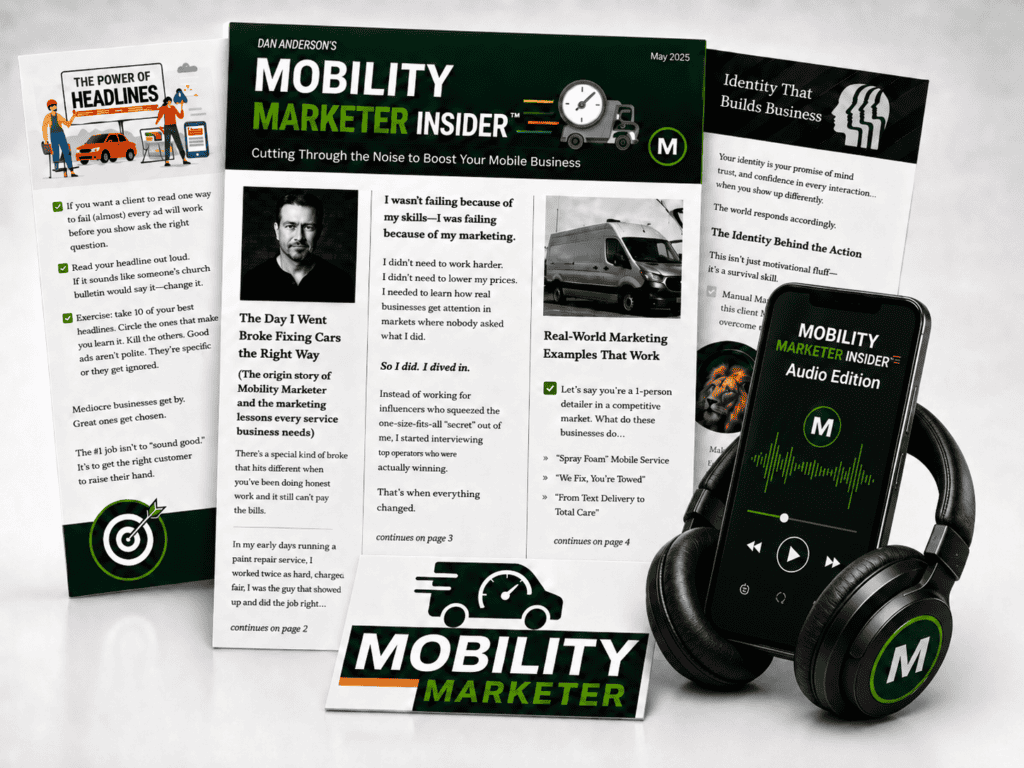
Start With the Free Special Edition of Mobility Marketer Insider™
You don’t need another mountain of material staring at you from a downloads folder. You need a sharp starting point built for the reality of running a service company: limited time, constant interruptions, expensive mistakes, and customers who won’t pause their lives while you study marketing theory.
That’s why you should get the Free Special Edition of Mobility Marketer Insider™—including the audio edition.
This isn’t designed to give you a temporary burst of motivation that evaporates before your next appointment. It’s designed to help you look at your marketing with more profitable eyes. You’ll begin noticing weak messages that blend into the market, missed opportunities hiding inside ordinary customer contact, and quiet leaks that allow interested prospects to drift away without a fight.
Read the Special Edition when you can sit down and mark the ideas that hit closest to home. Then play the audio while driving, preparing for the day, or handling work that doesn’t require your full attention. That second exposure matters. The sentence you skimmed may become the one you hear. The idea you understood may become the one you finally use.
You get both formats free because useful marketing shouldn’t depend on having a silent office, an empty schedule, and two uninterrupted hours that may arrive shortly after flying cars.
The Free Special Edition gives you a practical entrance into the Mobility Marketer way of thinking: direct, measurable, customer-focused, and built around action. No ceremonial business language. No advice that sounds impressive but collapses when introduced to a real customer. The purpose is to help you attract attention, create desire, improve response, and build a company that doesn’t have to beg the market for its next job.
Download it. Read it once. Listen to the audio. Then return to it after you’ve had time to notice where the lessons touch your own business. That’s how an idea moves from interesting to useful—and from useful to profitable.
The lesson you need may already be waiting inside.
The uncomfortable question is whether you’ll recognize it before it sends another customer, another job, and another chunk of revenue somewhere else.
Get the Free Special Edition of Mobility Marketer Insider™ with audio now. Give it your attention once, give it your ears again, and give your business the advantage of lessons that don’t disappear five minutes after you learn them.