The Fastest Money in Your Business Is Probably Sitting in a Drawer, Getting Dusty
Posted on by Dan Anderson
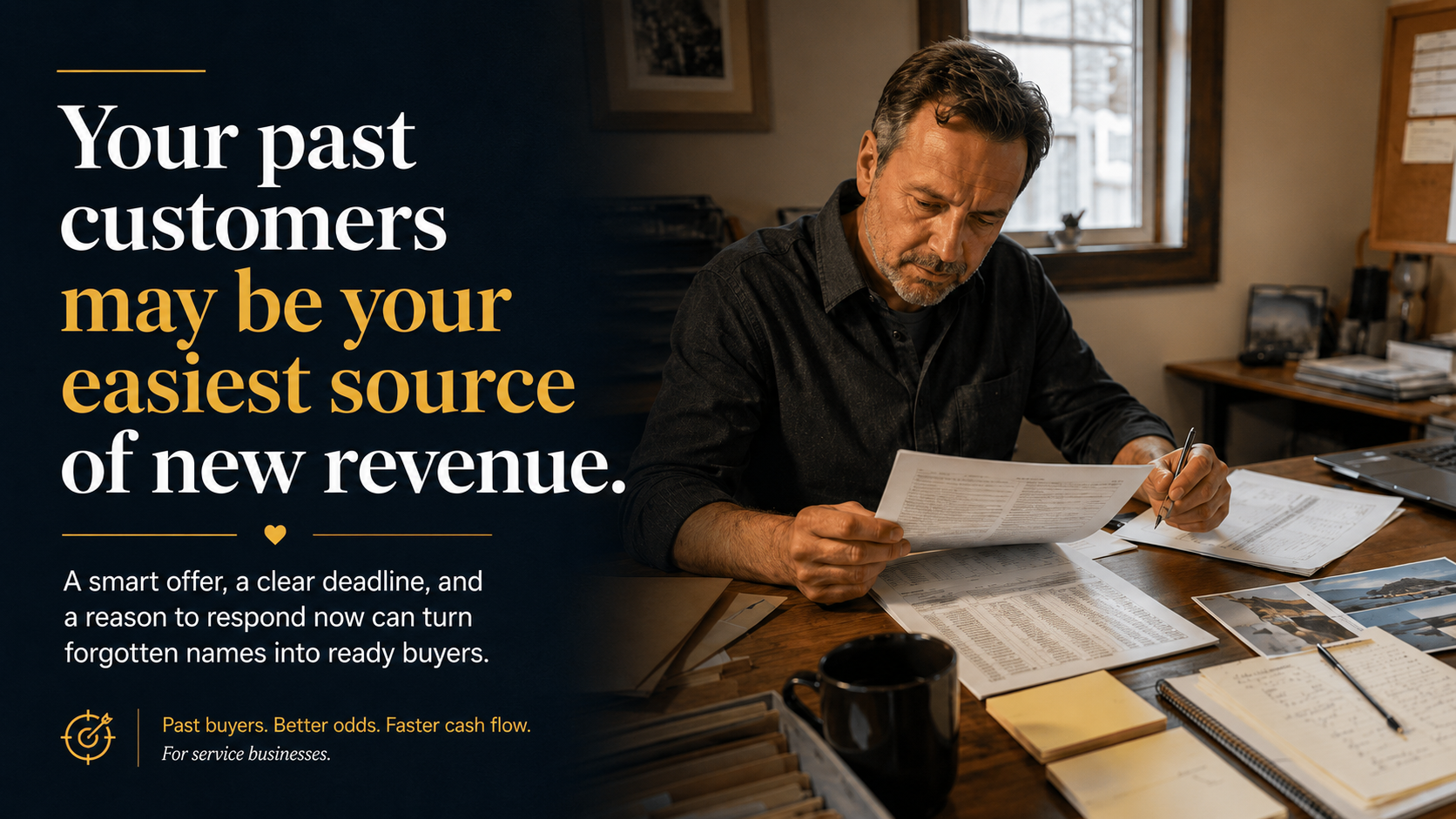
Your fastest cash flow surge may not come from new leads, new ads, or another shiny marketing toy. It may be sitting in your forgotten past customer list, waiting for a smart offer, a clear deadline, and a reason to come back now.
You are likely sitting on a pile of money and treating it like old receipts, dead batteries, and those mysterious keys in the junk drawer nobody has the nerve to throw away. That pile of money is not a new ad campaign, a new social media trick, or a magical piece of software with a dashboard full of blinking lights. It is your past customer list.
These are not strangers. These are not cold leads. These are not people who clicked one ad three Tuesdays ago and disappeared into the digital swamp with the rest of the tire-kickers, price-shoppers, and digital window-lickers. I am talking about people who have already hired you, already trusted you, already let you into their home, office, driveway, garage, building, carpet, vehicle, yard, crawlspace, or whatever strange little battlefield your particular service business occupies.
That is a very different kind of person. A past customer already crossed the hardest bridge. He decided you were safer than the other suspects in town. He gave you money. He let you perform the work. He saw the result. And then, in most service businesses, he was promptly abandoned like an umbrella at a restaurant.
The owner goes right back to chasing new leads like a dog chasing a squirrel on espresso. New ads. New posts. New platforms. New software. New offers. New marketing tricks. New headaches. Meanwhile, the easiest money in the business is sitting quietly in the old customer file waiting for someone with half a brain, a decent offer, and enough discipline to send a message.
Your past customers are not dead. They are neglected.
That is an important distinction. A dead customer cannot buy. A neglected customer simply has not been invited back properly. Most service business owners make the expensive mistake of assuming that if the customer needs them again, the customer will remember them. That sounds reasonable until you remember that customers are actual human beings, and human beings forget where they put their glasses while the glasses are already on their face.
Customers do not sit around lovingly thinking about your service business. They are not gathered at the dinner table saying, Remember that fellow who cleaned the carpet, fixed the bumper, washed the windows, repaired the siding, detailed the car, trimmed the trees, or removed the mildew from the patio? What a noble craftsman. We must call him again before the next moon. No. They are busy. They have jobs, kids, bills, maintenance problems, pets, appointments, inboxes, and at least one relative who turns every family gathering into a courtroom drama.
Your customer may have loved your work. He may have been perfectly satisfied. He may even have meant to call you again. But memory is weak, life is loud, and attention is expensive. When you disappear, you become part of the fog. That is how repeat business leaks out of a company, not because the customer hated you, but because you failed to stay visible.
This is where the cash flow surge comes in. A cash flow surge is not a prayer whispered over QuickBooks while hoping invoices magically appear. It is a deliberate campaign sent to past customers with one purpose: get people who already trust you to raise their hand again. For a service business, this can be one of the fastest ways to create immediate appointments, immediate conversations, and immediate money without spending a fortune hunting strangers.
The reason this works is painfully simple. The sale is not starting from zero. A cold prospect has to decide who you are, whether you are trustworthy, whether you are any good, whether your price is fair, whether you will show up, whether you will damage something, whether he will regret hiring you, and whether his spouse will later ask why he hired a man whose business card looks like it was printed during a power outage. That is a lot of friction.
A past customer has already crossed most of those bridges. You already got through the door once. You already performed. You already became familiar. That does not mean the customer will automatically buy again, but it does mean the wall is lower. You are not shouting over the fence at a stranger. You are knocking on the door of someone who already knows your face.
The cheapest customer to get is often the customer you already paid to get years ago.
Think about that for a moment. That first customer may have cost you advertising money, time, gasoline, quoting, scheduling, messaging, follow-up, and possibly three conversations with someone who wanted you to come after work, before dinner, during the dog’s nap, but not when the neighbor’s leaf blower was running. You paid for that customer. Then, like most owners, you let him drift away like a balloon at a county fair.
That is not marketing. That is business amnesia. A reactivation campaign is how you cure it.
The offer does not need to be complicated. In fact, complicated offers are where response goes to die wearing a little name tag. What you need is a simple, believable, valuable reason for the past customer to pay attention again. One of the strongest ways to do this is with a free-service certificate, a preferred-customer gift, or a limited return-client offer.
For a carpet cleaner, it might be one room cleaned free.
For a pressure washer, it might be a free sidewalk section with a house wash.
For a window washer, it might be a free front-entry glass cleaning with a whole-house service.
For a mobile detailer, it might be a free interior refresh with a full detail appointment.
For a mobile paint repair specialist, it might be a limited repair credit or a last-minute schedule-filler offer tied to a specific open slot.
The exact service can change. The structure should not. You are saying: you were a customer before, we have not seen you in a while, we have a short window before the schedule fills, and here is a valuable reason to call now. That is much stronger than sending one of those limp little messages that says you are just checking in.
Just checking in has all the selling power of damp toast. It tells the customer you have no offer, no angle, no urgency, and no clear reason for interrupting his day. A real reactivation campaign gives the customer a reason to care. It also gives you a reason to make contact without sounding needy.
The reason behind the offer should be believable. Do not insult the customer with fake scarcity that smells like discount-bin cologne. Use a real reason. You have openings before busy season. You are filling slow days. You are rewarding past customers before advertising to the public. You are reconnecting with people you enjoyed serving. You are giving select past clients first chance at a preferred offer before the schedule gets crowded.
That kind of reason feels human. It feels plausible. It feels like something a real business owner would actually do. And believability is the oxygen of an offer. Without it, the whole thing suffocates.
The customer has to believe the offer is real. He has to believe the reason makes sense. He has to believe the value is genuine. He also has to believe there is some advantage to acting now instead of mentally filing your message under later, which is where good intentions go to be forgotten.
A strong reactivation campaign should also carry a little warmth. Not syrup. Not begging. Not some desperate please come back, we miss your money letter that sounds like it should be accompanied by violin music and a wet napkin. Just a simple acknowledgment that this person has done business with you before and is being treated differently because of it.
That is powerful because people like to feel recognized. They may pretend they do not, because adults enjoy lying about their own psychology, but they do. Phrases like past customer, preferred client, select customer, private offer, and first notice can work well when they are used truthfully. You are not merely advertising. You are making the customer feel noticed.
Then you need a deadline. Not a fake emergency. Not a screaming countdown timer. Not marketing theatrics that make your offer look like it escaped from a carnival. Just a clean, clear deadline. The offer expires on a specific date. The certificate must be used by a specific date. The openings are available until a specific date. The reason is simple: without a deadline, the customer waits.
And when customers wait, they forget. When they forget, your message becomes archaeology. A deadline turns a nice idea into a decision. Marketing is not there to be admired. It is there to create action.
No deadline means no urgency. No urgency means no action. No action means you are just decorating the customer’s mailbox.
This is where many service business owners get weak. They are willing to spend money on ads, buy software, post on social media, and complain about slow weeks, but they get nervous about making a clear offer with a clear expiration date. That is not kindness. That is expensive hesitation wearing church shoes.
Now let’s deal with the word free, because this is where some owners start grabbing their chest like somebody set fire to the cash drawer. Free does not automatically mean stupid. There is stupid free, and there is strategic free. Stupid free is giving away your time to people who never valued it and never will. Strategic free is offering a small, controlled, high-perceived-value service to past customers who have already proved they can buy.
That is bait with a business purpose. Some people will take only the free item and nothing else. Fine. Build the math so that does not kill you. Limit the size. Limit the quantity. Limit the appointment windows. Limit the offer to past customers. Limit the expiration date. Make it valuable enough to get attention and controlled enough to protect your profit.
A carpet cleaner offering one free room does not need to clean the entire mansion, the guest house, and the emotionally neglected rug in the hallway. A pressure washer offering a free sidewalk section does not need to wash the county. A detailer offering a free add-on does not need to perform a four-hour resurrection on a minivan that smells like yogurt, crayons, and broken dreams. The offer should be generous, not suicidal.
A good reactivation campaign also reminds customers of the good result they enjoyed last time. This matters because customers do not always remember the technical service. They remember the relief. They remember how clean the room felt. They remember how sharp the car looked. They remember how much brighter the house looked when the grime disappeared. They remember how nice it was to stop being irritated by the problem.
Do not merely remind them of the job. Remind them of the after-feeling. That is where the buying impulse lives. People buy services to remove irritation, restore pride, avoid embarrassment, and feel in control again. The technical work matters, of course. But the action is usually triggered by emotion.
A cash flow surge campaign should gently poke that emotional bruise. Not brutally. Just enough. It has probably been longer than you think. You have been meaning to handle this. Life gets busy. The job keeps getting pushed aside. Here is an easy way to finally get it done. That is persuasion without pressure. It enters the conversation already happening in the customer’s head.
The truth is that many customers are not deciding against you. They are simply postponing maintenance. They are avoiding chores. They are distracted. They are letting small problems become normal. Your campaign gives them a nudge, and sometimes a nudge with a gift certificate attached is all it takes to put money back on the calendar.
This should not be something you do once every seven years like some kind of marketing eclipse. It should become part of your business rhythm. Past customers who have not purchased in six months, nine months, twelve months, or eighteen months should be grouped and contacted with appropriate offers. The timing depends on your trade, but the principle holds: every customer list should have a reactivation system.
Not a vague hope. A system.
Once a month, pull a list of customers who have not booked in the appropriate time window. Send a letter, card, email, or text campaign with a clear return offer. Track replies, track appointments, track revenue, and track referrals. Then repeat. This is how a business becomes less dependent on new-lead panic.
New leads are important, but a business built only on new leads is like a man filling a bathtub with the drain open while congratulating himself on owning a faucet. Follow-up plugs the drain. Reactivation brings old money back into circulation. Yes, that image is unpleasant, but it is accurate enough to be useful.
Your customer list is not merely contact information. It is stored trust. Stored trust can be turned into cash faster than cold attention. That does not mean abusing the list. It means communicating with it intelligently, respectfully, and regularly. You do not beat your past customers to death with constant discounts, and you do not train them to wait for coupons like pigeons waiting for breadcrumbs. You use selective, reason-based offers that protect your positioning.
This matters because a reactivation campaign should not make you look cheap. It should make you look smart, generous, and busy enough to have a reason for a limited offer. There is a big difference between we are desperate for work and we are giving past customers first opportunity before the schedule fills. One smells like panic. The other smells like preference.
This is especially useful before busy season, after a slow stretch, before holidays, after pollen season, before winter, before spring, before guests arrive, before school starts, before selling a home, or after any period when your service naturally becomes relevant again. Tie the offer to something already happening in the customer’s life, and your message feels timely instead of random.
Random marketing is easy to ignore. Timely marketing feels useful. Useful sells.
Here is the hard truth: most small service businesses do not need more complicated marketing. They need to do the obvious profitable things they keep ignoring. Past-customer reactivation is one of those things. It is not glamorous. It will not make you feel like a tech genius. It does not require a funnel map that looks like electrical wiring designed by a caffeinated octopus. It requires a list, a message, an offer, a deadline, and follow-up.
That is why many owners will not do it. They would rather chase something new than execute something proven. New feels exciting. Proven feels boring. But boring has a nasty little habit of depositing money.
A good reactivation campaign can fill holes in your schedule, wake up sleepy customers, generate referrals, create repeat work, and remind people why they hired you in the first place. It can also teach you which customers are still responsive, which offers work, which seasons produce action, and which parts of your old customer base are worth keeping close.
So stop treating your past customer list like a museum. Pull it out. Sort it. Find the people who have not hired you in the last twelve months, or whatever time period fits your business. Create a simple, controlled, valuable offer. Give them a real reason. Give them a deadline. Remind them of the result they enjoyed last time. Tell them exactly what to do next. Then track what happens.
Do not overthink it until the idea dies of committee poisoning. This is not complicated. A service business that cannot reactivate past customers is usually not suffering from a lead problem. It is suffering from a follow-up problem. And that is good news, because follow-up is fixable.
Your next cash flow surge may not be hiding in a new ad campaign, a new platform, or a new marketing toy with a monthly fee and a dashboard full of useless little fireworks. It may be sitting in the names of people who already trusted you once. Wake them up. Invite them back. Give them a reason to act.
The money is closer than you think.
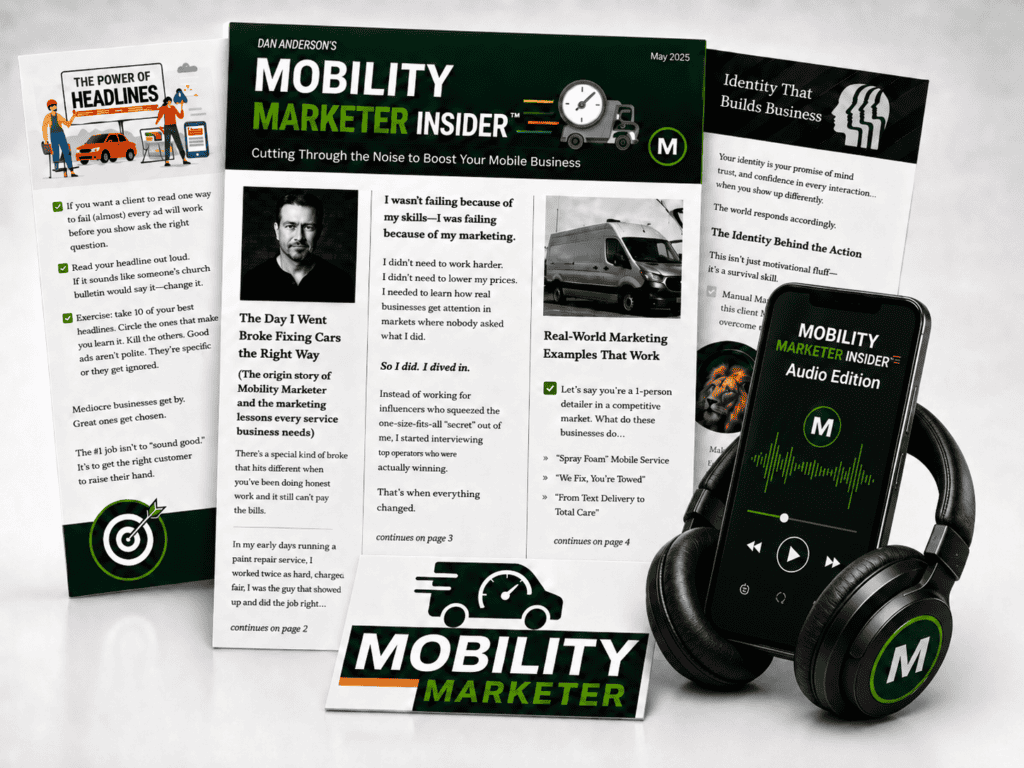
Grab the free special edition of Mobility Marketer Insider™ at mobilitymarketer.com.
mobilitymarketer.comIt was created for service business owners who are tired of chasing strangers, getting compared by price, and letting good past customers quietly disappear into the fog. Inside, you’ll see how one painful business lesson became a sharper way to think about marketing, positioning, customers, and profit.
And yes, it’s free.
No tiny-print circus act. No academic lecture wearing a necktie. No stale business advice that sounds like it was written by a committee trapped in a beige conference room. Just a practical, field-tested special edition built for operators who want better customers, stronger follow-up, and a business that stops begging for attention like a sad little yard sign in the rain.
Download the free special edition at mobilitymarketer.com.
Read it. Print it. Mark it up. Then use it before another good customer slips away and hires someone cheaper, weaker, and louder.