The Marketing Strategy That “Failed” Because You Never Finished It
Posted on by Dan Anderson
Before you throw another campaign in the trash, make sure you actually ran the whole thing. A surprising amount of supposedly “bad marketing” is simply good marketing abandoned halfway through.
There’s a particular form of marketing insanity that deserves its own diagnostic code. A service operator gets excited about a new campaign, creates the first advertisement, sends the first email, mails the first letter, posts the first offer, and then waits approximately long enough to microwave a burrito before beginning to wonder why customers haven’t formed a line around the building.
A few days pass. Maybe there are a couple of responses, maybe there aren’t. The campaign begins feeling less exciting, actual work gets in the way, somebody forgets the next step, and before long the entire strategy gets tossed into the great marketing graveyard with a tombstone reading: “We Tried That. It Didn’t Work.”
Except there’s one irritating little problem.
You didn’t try it. You tried part of it.
That difference can cost a service business an absurd amount of money.
Marketing Isn’t an Event. It’s a Machine.
Think about how absurd it would be to judge anything else the way people judge marketing. You wouldn’t put two tires on a truck, leave the other two in the garage, and announce that automobiles are an overrated technology. You wouldn’t install half an air-conditioning system and conclude that refrigerant is a scam because the living room is still 91 degrees.
Yet people do exactly this with marketing.
A campaign designed around several contacts gets reduced to one. A follow-up process becomes “we called him once.” A customer reactivation sequence becomes one email sent during a quiet Tuesday afternoon. A referral program consists of occasionally remembering to say, “Tell your friends about us.”
Then everybody acts surprised when the results look like a flat tire.
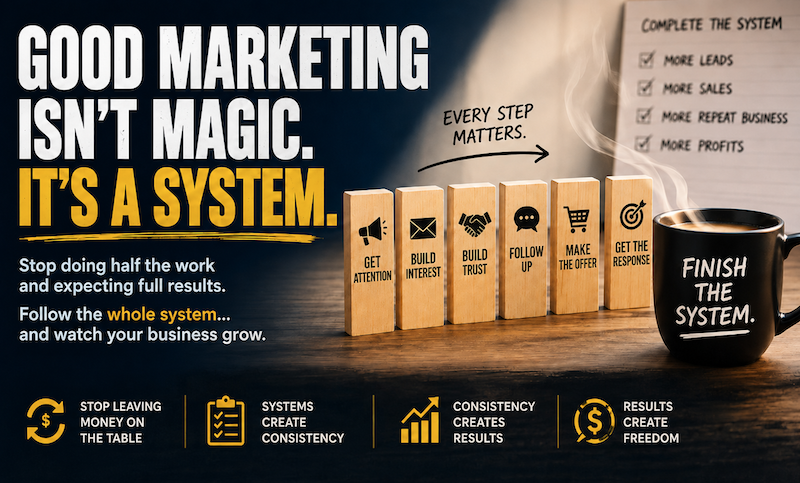
A marketing system works because the pieces work together. The first contact has one job. The second has another. The follow-up reinforces the message. The proof reduces uncertainty. The offer provides motivation. The call to action directs the prospect. The next contact arrives because human beings are distracted, forgetful creatures who can walk into a kitchen and forget why they’re there.
Remove enough pieces and the machine stops being a machine.
It becomes a pile of parts.
Your Prospect Has Other Things to Think About
Here’s something worth remembering the next time you become emotionally wounded because somebody ignored your beautiful advertisement.
Your prospect wasn’t waiting for it.
They didn’t wake up that morning thinking, “I wonder whether Gary’s Pressure Washing is finally going to explain his patio package to me.”
They were thinking about work, school, groceries, bills, the dentist, their daughter’s text message, the strange noise coming from the washing machine and whether the dog just ate something it shouldn’t have.
Then your marketing appeared.
Maybe they noticed it.
Maybe they didn’t.
Maybe they glanced at it and thought, That looks interesting.
Then the phone rang.
Gone.
That doesn’t mean the message failed. It means the prospect has a life.
This is why effective marketing often requires repeated contact. The first message can introduce you. The second makes your name familiar. The third may reach the prospect at precisely the moment when their need changes from “I ought to do something about that someday” to “I’m sick of looking at this thing.”
You don’t control when the prospect becomes ready.
You can control whether you’re still around when they do.
The First Letter Isn’t Supposed to Carry the Piano by Itself
Suppose you create a three-part direct-mail campaign.
Letter one introduces the problem and creates curiosity. Letter two approaches the subject from another angle, adds additional credibility and reminds the prospect that the problem hasn’t disappeared. Letter three creates another reason to act and gives the prospect one more opportunity to respond.
Now imagine mailing Letter One and stopping.
You haven’t tested your three-part campaign.
You’ve tested Letter One.
That sounds painfully obvious when written down, yet this is exactly how marketing gets abandoned every day.
The same problem shows up online. Someone runs an advertisement directing people to a landing page, but there’s no follow-up after the visitor leaves. Someone collects an email address and sends one message. Someone provides an estimate and assumes interested prospects will magically remember to call back.
Each missing step quietly transfers control from your system to chance.
And chance is an unreliable employee. It rarely shows up on time and apparently has no interest in your quarterly revenue goals.
The Coffee-Maker Test
Here’s a useful way to think about this.
Imagine deciding to make coffee in the morning. You put the filter in the machine, scoop the coffee into it, close the lid and walk away.
Twenty minutes later you return.
No coffee.
You stare at the machine suspiciously.
“This thing doesn’t work.”
Except you forgot the water.
And the pot.
And the minor technical detail of turning the machine on.
Nobody would blame the coffee maker. You didn’t complete the process.
Marketing is no different.
You can have the right audience, a strong offer and an excellent sales message, but if you neglect the rest of the system, you can still produce absolutely nothing.
Incomplete marketing frequently masquerades as ineffective marketing.
That’s dangerous because it sends you searching for another strategy when the one you already had may have been perfectly capable of producing customers.
You didn’t need another strategy.
You needed to finish your coffee.
This Is Why “Trying Things” Gets Expensive
Random marketing activity has a strange ability to make an operator feel productive.
You boosted a Facebook post.
You sent an email.
You mailed postcards.
You changed the homepage.
You made a new logo.
You posted three videos.
Look at all that marketing!
Unfortunately, activity and accomplishment are not the same thing.
A disconnected pile of tactics can consume enormous amounts of time without creating a dependable flow of customers. What matters is whether those tactics are connected to a process that moves a prospect toward a sale.
An advertisement should lead somewhere.
The lead should receive something.
The prospect should be followed up with.
The estimate should trigger another communication.
The customer should enter a retention process.
The happy customer should be encouraged to leave a review and refer somebody.
The inactive customer should eventually hear from you again.
Now you have a system.
Without those connections, you’ve got marketing confetti.
It looks festive right up until you check the bank account.
The Biggest Leak May Be After the Lead Arrives
This is where the discussion gets particularly uncomfortable because service companies frequently assume their biggest problem is not getting enough leads.
Sometimes it is.
But sometimes they’re already generating enough opportunities and simply losing too many of them.
Imagine 50 people request information this month. Several don’t receive a fast response. More receive estimates but never hear from you again. Some become customers but disappear afterward because there’s no retention process. A few are thrilled with the work, but nobody asks them for a review or referral.
At the end of the month, somebody looks at the advertising bill and says, “These leads are too expensive.”
Maybe.
Or maybe you paid for 50 opportunities and only completed half the system required to monetize them.
That is a very different problem.
And fortunately, it’s often much easier to fix.
The Most Profitable Question May Be: “What Happens Next?”
Take any point in your customer journey and ask those three words.
Someone sees your advertisement.
What happens next?
They request an estimate.
What happens next?
They receive the estimate but don’t reply.
What happens next?
They buy.
What happens next?
They tell you they’re thrilled.
What happens next?
They haven’t purchased anything for eight months.
What happens next?
Whenever the answer is “nothing,” you may have discovered a broken section of the machine.
That’s the beauty of thinking in systems. You stop depending on memory, mood and heroic bursts of motivation. The process decides what happens next.
And today, much of that process can be automated. Emails can be scheduled. Estimate reminders can be triggered. Review requests can be sent automatically. Reactivation campaigns can run at predetermined intervals. Direct-mail sequences can be placed on a calendar before the first piece goes out.
You don’t have to remember everything.
The system remembers for you.
Stop Declaring Campaigns Dead Prematurely
There’s another discipline required here: don’t judge a campaign until you’ve actually completed the campaign.
Run the sequence.
Track the results.
Then diagnose it.
Maybe the headline is weak. Maybe the audience is wrong. Maybe the offer needs improvement. Maybe the timing is poor. Maybe the call to action isn’t clear enough.
Fine.
Fix what’s broken.
But you can’t intelligently diagnose a machine when half the machine was never assembled.
Complete first. Measure second. Improve third.
That’s considerably less exciting than hopping from platform to platform every two weeks, but it has one enormous advantage.
It produces knowledge.
After enough complete campaigns, you begin discovering what actually works in your market. You know which offers pull. You know which follow-ups matter. You know how many touches tend to be required. You know which customers respond best.
Now your marketing begins becoming an asset instead of an experiment.
Before You Start Another Campaign, Look at the Unfinished Ones
There may already be money hiding inside your business.
Look for the direct-mail campaign that stopped too early.
Look for the estimates nobody followed up.
Look for the customer list that hasn’t heard from you in a year.
Look for the referral process everyone agrees is important but nobody actually executes.
Look for the email sequence with three messages written and six still sitting on the to-do list.
Look for the excellent strategy that received a lousy funeral because everybody got busy halfway through.
The next marketing breakthrough may not require starting something new. It may require finishing something old.
And that’s the kind of breakthrough I like because it doesn’t require another app, another agency, another platform, another subscription or another 47-minute webinar explaining how everything you currently know became obsolete sometime last Thursday.
Sometimes the answer is considerably simpler.
Finish the system.
Then judge it.
Get the FREE Special Edition of Mobility Marketer Insider™ + Audio Edition
If you run a service business and you’re tired of scattered promotions, forgotten follow-up and marketing that seems to begin from zero every time the phone slows down, the FREE Special Edition of Mobility Marketer Insider™ was created with you in mind.
Inside, you’ll discover practical direct-response strategies for attracting better prospects, making stronger offers, improving follow-up, generating more repeat business and referrals, and turning individual marketing tactics into systems that keep working after the first advertisement has disappeared from sight.
And because service operators tend to spend more time behind a steering wheel, carrying equipment and solving customer problems than sitting peacefully in a leather chair pondering marketing theory, you’ll also receive the complete audio edition.
Read it when you can. Listen while you work. Then put the strategies into action—and this time, finish the entire system.
Get the FREE Special Edition of Mobility Marketer Insider™ + Audio Edition at