The Social Media Hostage Situation That Can Quietly Starve Your Service Business
Posted on by Dan Anderson
Why service operators should use social platforms without handing them control of their leads, customer relationships, and next paycheck.
The dangerous little fantasy floating around the service business world says that if you post often enough, collect enough followers, and keep feeding a social media platform fresh content, customers will eventually arrive in a neat line with credit cards in hand.
That fantasy is comforting. It’s also how an operator can spend six months making videos while the phone sits there with the enthusiasm of a dead houseplant.
Social media isn’t useless. It can display your work, introduce your personality, showcase customer reviews, and help local prospects recognize your company. But there’s a huge difference between using social media and depending on social media.
Social media should be a fishing pole. It should never become the lake you pretend to own.
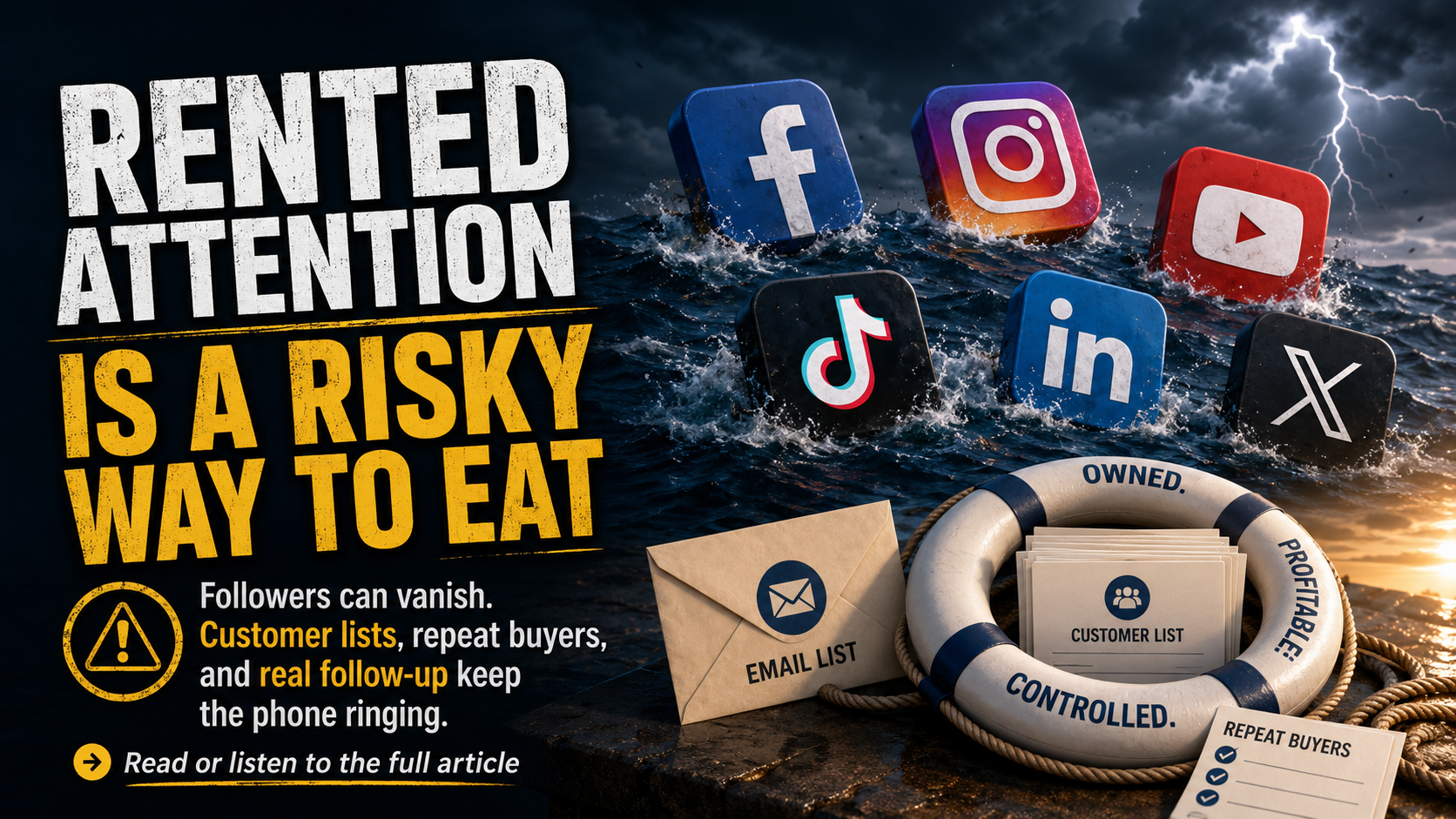
You’re Building on Rented Land
Your social media page may carry your logo, photos, videos, customer comments, and years of effort. None of that means you own the ground underneath it.
The platform owns the account. It controls the rules. It decides how much access you get to the audience you worked to attract. It can reduce your reach, change the preferred format, push paid promotion, restrict your account, or suddenly decide that the only content worthy of attention is a thirty-second video involving captions, dramatic pointing, and a grown adult dancing beside a work truck.
You can complain. You can appeal. You can write a strongly worded post to the company that stopped showing your strongly worded posts. The platform will remain emotionally stable throughout the crisis.
That’s the first danger: you’re investing labor into an asset controlled by someone else.
No sensible service operator would spend years improving a landlord’s property while refusing to build anything of his own. Yet that’s exactly what happens when someone builds a social audience but never builds a customer database, email list, mailing list, or direct follow-up system.
The followers may recognize your name, but the platform controls whether you’re allowed to reach them.
Followers Aren’t a Customer List
A follower isn’t the same as a customer. A like isn’t permission to contact someone whenever you choose. A comment isn’t a reliable pipeline. A large view count may feel good, but the electric company remains stubbornly old-fashioned and continues asking for money.
A customer list is different. It’s an owned business asset. It gives you the ability to contact people who’ve already bought, requested information, asked for an estimate, downloaded a guide, joined your newsletter, or otherwise raised their hand.
A social audience can disappear behind an algorithm. A customer database can be backed up, organized, mailed to, emailed, texted with permission, and used to create repeat work, referrals, and reactivation campaigns.
That’s why a service business with 400 real customer records may be in a stronger position than a social account with 20,000 followers and no direct contact information.
The number that matters isn’t how many people watched. It’s how many people you can reach again without asking a platform for permission.
Activity Can Disguise the Absence of Marketing
Social media gives the operator constant little rewards. A notification appears. Someone leaves a fire emoji. A stranger writes, “Great work.” Your brain receives a tiny cookie and whispers, “We’re marketing.”
Maybe you are.
Or maybe you’re creating free entertainment for a company with a larger bank account than yours.
Real marketing should move a prospect toward a measurable action. They request an estimate. They call. They download a guide. They join a list. They schedule. They buy. They return. They refer someone.
Posting without a direct next step is often public activity wearing business clothes. It looks busy, but motion isn’t the same as movement.
One operator can spend an hour polishing a post while a competitor spends fifteen minutes contacting past customers. The competitor may book three jobs before lunch. The first operator may receive nine thumbs-up reactions and a private message from a fake account offering “explosive brand growth.”
That’s the trap. Social media can make you feel productive while quietly pulling your attention away from strategies that produce trackable revenue.
The Algorithm Doesn’t Care About Your Payroll
The platform has its own objectives. It wants attention, content, ad revenue, and users who remain inside the app.
Your need to fill Thursday afternoon isn’t one of its sacred duties.
Your reach can rise and fall without your message changing. The platform may reward one format today and bury it next month. Your followers may never see the offer you worked all evening to create.
Your agenda is much simpler. You need to attract the right customer, make a profitable sale, do excellent work, create repeat business, and earn referrals.
Social media can support that agenda, but it shouldn’t replace it.
A restriction, hack, suspension, identity check, or password problem can lock you outside your digital storefront while a robot asks whether you’ve tried restarting your life.
A real marketing system should survive one platform having a bad day, a bad month, or a sudden personality disorder.
Attention Without Buying Intent Is Mostly Noise
A person can admire your bumper repair from three states away. Someone can watch landscaping clips while living in an apartment where the largest patch of grass belongs to the dog park.
That attention may help visibility, but it doesn’t automatically create revenue.
Attention without local need, buying power, timing, or intent is mostly noise. The right 100 local prospects can be worth far more than 100,000 random viewers who’ll never buy.
Your marketing should attract people who have the problem you solve, live inside your service area, value the result, and can afford the service.
Then it should give them a clear path to respond.
That path might be an estimate request, a useful guide, a seasonal offer, a maintenance checklist, a neighborhood service package, or a simple invitation to join your newsletter.
Social media becomes valuable when it feeds people into that path. It becomes dangerous when the view count itself is treated as the finish line.
The Content Treadmill Never Stops
Yesterday’s post quickly disappears. Today requires another. Tomorrow demands a video. Then come captions, comments, messages, trends, editing, music, hashtags, and the pressure to “stay consistent.”
Soon the operator who wanted freedom has created another job. The new boss is an app that pays nothing and demands content before breakfast.
This can make sense when the content supports a larger system. It becomes foolish when content creation is the entire system.
A customer guide, email sequence, direct-mail piece, referral campaign, or reactivation message can continue producing value after the day it’s created. A social post often has the shelf life of warm milk.
The answer isn’t to quit social media. The answer is to stop giving temporary content permanent control over your marketing.
You don’t need to post seven days a week just to prove you still exist. You need enough useful content to attract attention, demonstrate competence, and send the right people toward assets you control.
Turn Rented Attention Into Owned Relationships
The smart strategy is simple: use social media to begin the relationship, then move interested people into a system you own.
Send them to your website. Offer a useful guide, checklist, report, quote request, maintenance reminder, or special service package. Collect permission-based contact information. Follow up through email, direct mail, phone, or text where appropriate. Add customers to a real database after the job.
Now social media becomes a feeder channel instead of a fragile kingdom.
Your post creates attention.
The link sends the visitor to a page.
The page makes an offer.
The prospect joins your list.
The follow-up builds trust.
The customer buys.
The database keeps the relationship alive.
That’s marketing with a spine.
You can then build strategies that don’t depend on constant public posting. Customer reactivation campaigns can bring back buyers who’ve forgotten you. Referral requests can turn satisfied customers into introductions. Neighborhood mailings can help you build tighter routes. Seasonal promotions can fill slow periods. Reminder systems can bring customers back before they begin shopping again.
When those systems exist, social media becomes useful instead of terrifying. You can post without needing each post to rescue payroll.
Use Social Media, but Refuse to Be Owned by It
A balanced service business uses social media for visibility, proof, personality, and discovery. It doesn’t confuse those benefits with ownership.
The rule is simple: never let rented attention become your only source of customers.
Build the list. Build the database. Build the website. Build the follow-up. Build the referral system. Then use social platforms to pour qualified prospects into that machine.
When the algorithm changes, your customer list still exists. When reach drops, your follow-up still works. When an account gets restricted, your phone number, website, email list, mailing list, and customer relationships remain yours.
That’s the difference between using social media as a tool and letting social media use your business as content.
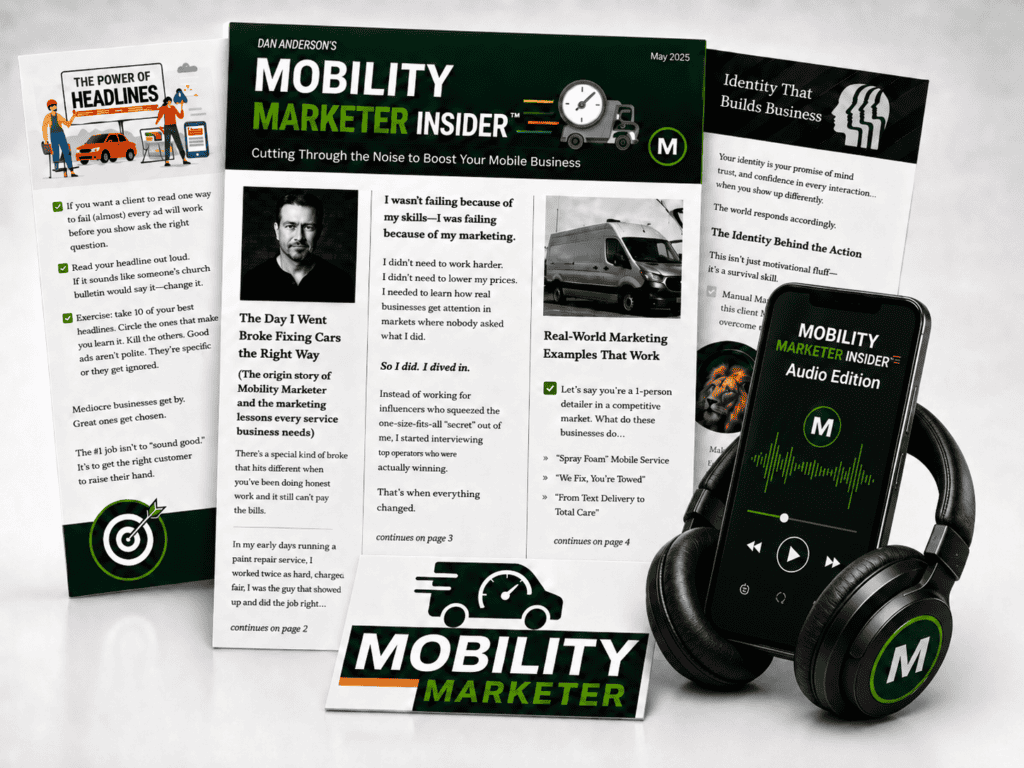
Get the Free Special Edition of Mobility Marketer Insider™
Getting customers shouldn’t depend on posting harder, chasing trends, or hoping a platform rewards you for being a good little content machine.
That’s why I created Mobility Marketer Insider™, a practical marketing newsletter for mobile and service-based operators who want customer-getting strategies they can understand, control, and put to work.
The Free Special Edition shows how to think beyond rented attention and begin building a stronger marketing foundation around direct response, clear offers, customer follow-up, repeat business, referrals, and owned customer relationships.
It also includes an audio edition, so you can listen while driving between jobs, cleaning equipment, loading the truck, handling paperwork, or completing the other glamorous duties nobody mentions when they tell you to “be your own boss.”
Get the Free Special Edition of Mobility Marketer Insider™, including the audio edition, and subscribe at:
mobilitymarketer.comRead it. Listen to it. Put the strategies to work so your business can still reach customers when the algorithm wakes up grumpy.