Your Work Truck Is Either Selling For You Or Quietly Telling Customers To Run
Posted on by Dan Anderson
Before customers trust your work, they judge your truck, your uniform, and the first impression that either lowers their fear or quietly sends the job to someone else.
There is a silent salesman riding around with you every day.
He does not talk. He does not ask for commission. He does not complain about gas prices, skipped lunches, sore knees, bad traffic, bad customers, or the guy who says, “It should only take five minutes,” right before handing you a problem that looks like it survived a tornado, a divorce, and three previous repair attempts.
That silent salesman is your presentation.
Your truck. Your uniform. Your shoes. Your grooming. Your estimate sheet. Your invoices. Your voicemail. Your text messages. Your tools. Your first ten seconds at the customer’s door.
Before you say one smart thing, before you explain your process, before you show your reviews, before you mention your experience, your customer has already started judging you. And no, they are not judging you fairly. Welcome to the marketplace. Fairness packed a suitcase years ago and left without forwarding its mail.
Customers judge fast. They judge visually. They judge emotionally. Then they use logic later to justify the decision their gut already made.
That means your service business is either building trust before the sale or dragging suspicion onto the customer’s porch like a muddy boot.
Professionalism is not decoration. It is pre-selling.
This matters in every service business because customers are nervous. They may not say it out loud, but they are. A stranger is coming to their house, touching their car, walking through their rooms, working near their family, handling expensive equipment, or promising to fix something they do not fully understand.
The customer is quietly asking, “Can I trust this person?”
That question is already in their mind before you arrive.
Here is the hard part. Your trade may already have a bad reputation even if you personally did nothing to earn it. The customer has heard stories. The guy who took a deposit and vanished. The cleaner who ruined the carpet. The mechanic who invented repairs like a novelist with grease under his nails. The handyman who showed up three hours late smelling like poor decisions. The pressure washer who blasted paint off the siding and called it “surface preparation.”
You may be honest. You may be skilled. You may be worth every dollar you charge.
But the customer does not know that yet.
So you have to overcompensate.
Not because it is fair. Because it is profitable.
A clean truck matters.
A service vehicle is not just transportation. It is a rolling billboard, a credibility signal, a neighborhood advertisement, and a trust test. If your truck looks like it escaped from a junkyard and has been living behind a gas station ever since, the customer does not think, “Ah, a hardworking professional.” They think, “Is this guy going to leak something in my driveway?”
Your vehicle does not have to be brand new. It does not need chrome wheels, leather seats, or a wrap so loud it makes birds change direction in midair. But it must look clean, organized, and cared for.
Customers connect how you care for your own equipment with how you will care for their property.
Dirty truck. Dirty thinking.
Messy van. Messy work.
Unmarked vehicle. Uncertain customer.
That may not be true, but it feels true. And in selling, what feels true often decides who gets the job.
A clean vehicle parked in a neighborhood also creates quiet advertising. People notice service vehicles. Homeowners are nosy. They may pretend they are checking the mail or taking the dog out, but they are looking at your truck, your logo, your setup, and your behavior. If you look professional, the neighbor stores that impression. Later, when they need that service, your name already feels familiar.
That is marketing you did not have to beg an algorithm for.
The customer is always watching before they are buying.
A uniform matters too.
A uniform separates the professional from the guy doing side jobs out of the back of a van with one working brake light and a personality built on cash discounts. It says, “I belong here. I am part of a real company. I have standards.”
This does not mean you need to dress like a hotel manager inspecting the lobby. A clean branded shirt, clean pants or shorts, and decent shoes can be enough. The point is consistency. The point is visual order. The point is making the customer feel like they opened the door to a professional, not someone’s cousin who “knows a guy.”
A uniform also makes pricing easier.
That sounds strange until you see it in the real world. A sharp service provider can often charge more than a sloppy one because the customer feels safer. Higher prices require trust. Trust requires signals. Uniforms are signals.
If you show up looking like you slept in the truck with a wrench for a pillow, you have already made your price harder to defend. The customer may still hire you, but now you are fighting a battle you created with your own shirt.
Grooming matters.
This is where some service pros get touchy. They say, “My work should speak for itself.”
That sounds noble, but it is also dangerously naïve.
Your work cannot speak before the customer lets you do it.
Before the work speaks, your face speaks. Your hands speak. Your hair speaks. Your smell speaks. Your shoes speak. Your posture speaks. Your first sentence speaks. Your grooming is part of the sales process whether you like it or not.
You do not need to look like a bank president. You do need to look like someone a reasonable homeowner would allow inside without hiding the silverware and texting their spouse, “I’m keeping the door open.”
Two-day stubble may be fine if it looks intentional. A week of wild growth that says “campground philosopher” is not the same thing. Dirty fingernails may happen during work, but starting an appointment that way is different. Stained clothes, bad odor, straggly hair, and a chaotic appearance all create resistance.
That resistance may never be spoken. It will simply appear as, “We need to think about it.”
Translation: “We are not comfortable enough to buy.”
Organization matters.
Customers love signs of order. A clean estimate. A simple process. A clear appointment window. A branded invoice. A text confirming arrival. A short explanation of what happens next. Tools arranged with purpose instead of scattered like a small explosion happened in the driveway.
Organization tells the customer their job is under control.
That feeling is valuable because people hire service businesses to reduce stress. Something is dirty, broken, damaged, leaking, ugly, overgrown, scratched, clogged, noisy, smelly, or embarrassing. They are not hiring you because life is perfect. They are hiring you because something is bothering them.
Your job is not just to perform the service.
Your job is to make them feel safe in the decision.
That starts with how you present yourself.
Professionalism lowers the customer’s fear before your sales pitch ever begins.
There is another hidden advantage. Professionalism makes your marketing more believable.
Your website can say you are reliable. Your truck proves it or disproves it.
Your ad can say you are detail-oriented. Your uniform proves it or disproves it.
Your Google reviews can say you are careful. Your first impression proves it or disproves it.
When your outer presentation matches your promise, trust compounds. When your outer presentation contradicts your promise, doubt multiplies like weeds after a week of rain.
A mobile detailer with a filthy vehicle has a problem.
A house cleaner with a disorganized kit has a problem.
A painter with paint-smeared clothes may look experienced, but if he looks careless, he has a problem.
A handyman with tools dumped into a bucket like lost treasure from a shipwreck may be talented, but the customer sees risk.
A mobile automotive repair specialist with a clean setup, sharp shirt, organized tools, and a calm explanation is not just selling repair. He is selling relief.
The real sale is always relief.
Relief that they hired the right person. Relief that the job will be handled. Relief that they will not have to chase you. Relief that they will not have to argue. Relief that they will not have to wonder whether you are competent, insured, sober, careful, organized, or likely to disappear into the same fog that swallowed the last guy.
Professional presentation answers those fears without making the customer ask.
That is why this matters so much.
It is not vanity. It is not corporate nonsense. It is not some motivational poster slogan that belongs in a conference room next to stale coffee.
It is money.
A professional appearance can help you close more estimates, get more repeat work, attract better customers, justify higher prices, and generate more referrals. It can also make your advertising work better because people who see your truck, uniform, and crew in the real world connect that image with your marketing later.
The service business owner who ignores this pays an invisible tax. Every sloppy impression costs a little. Every dirty truck costs a little. Every awkward first impression costs a little. Every moment of customer doubt costs a little.
You may never see the bill.
You just notice fewer people saying yes.
Then you blame price. Or the economy. Or cheap competitors. Or Google. Or Facebook. Or the customer.
Sometimes the problem is simpler.
You did not look like the safest choice.
And in service businesses, the safest choice often wins before the “best” choice ever gets a chance.
So clean the truck. Wear the shirt. Sharpen the first impression. Organize the tools. Tighten the appointment process. Clean up the invoices. Make the customer feel that doing business with you is orderly, safe, and smart.
This is not about pretending to be bigger than you are. It is about proving you are serious.
The amateur hopes the customer overlooks the mess.
The professional removes the reason to worry.
That one difference can change the way customers see you, trust you, hire you, remember you, and recommend you.
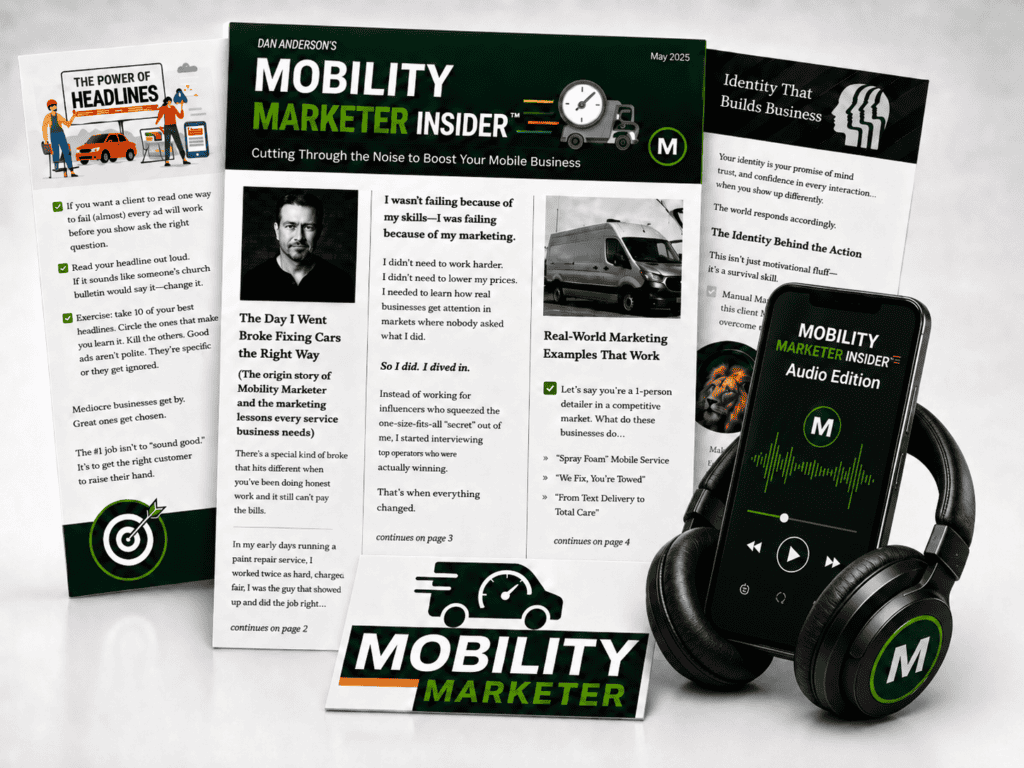
Get the Free Special Edition of Mobility Marketer Insider™
Getting customers should not feel like begging Google, chasing likes, or hoping strangers magically understand why your service is better.
That is why I created Mobility Marketer Insider™ — a practical marketing newsletter for mobile and service-based business owners who want sharper positioning, better offers, stronger follow-up, and a business that is easier for customers to trust and choose.
The Free Special Edition gives you a real look inside the kind of marketing strategies that help service businesses stop blending in and start standing out. You will see practical strategies you can use to make your business more memorable, more trusted, and more response-driven.
And because you are busy, there is also an audio version. You can listen while driving between jobs, cleaning equipment, loading the truck, or handling the daily chaos of running a real service business.
Get the Free Special Edition of Mobility Marketer Insider™, including the audio version, at:
Read it. Listen to it. Put it to work so your business starts attracting customers on purpose instead of waiting and wondering when the next call will come.