The $4.50 Trick That Can Make Customers Remember You, Rehire You, And Brag About You
Posted on by Dan Anderson
How to use small, thoughtful extras to make customers remember you, rehire you, and refer you without begging for attention like a coupon-waving maniac.
There is a peculiar habit in the service business world that quietly drains profits without anyone noticing at first. It is not dramatic. It does not announce itself with alarms. It simply settles in and becomes “the way things are done.” It is called “doing only what you were paid to do.”
Terrible habit.
The symptoms are easy to spot. The business owner shows up, performs the service, collects the money, vanishes, and then wonders why the customer acts like he was a passing thunderstorm instead of a trusted professional. Then, six months later, this same owner is standing in the driveway scratching his head, wondering why the customer hired someone else with a cheaper price, a louder ad, and a truck wrap that looks like a carnival ride.
Here is the unpleasant little truth. Customers do not remember average service. They remember pain. They remember inconvenience. They remember surprises. They remember when something goes wrong. And they remember when someone does something so thoughtful, so unexpected, and so obviously above the usual sleepy industry standard that their brain files it under: “That person is different.”
That is where the money is.
Not in being “professional.” Not in being “reliable.” Not in telling the customer you are “licensed and insured” as though you just descended from Mount Sinai carrying a pressure washer and a certificate of liability to bless the masses. Those things matter, but they are not enough. They are the minimum. Expecting a raving review for doing only what was expected is like expecting applause for showing up on time. It is the peas on the plate. Nobody writes a love letter about peas.
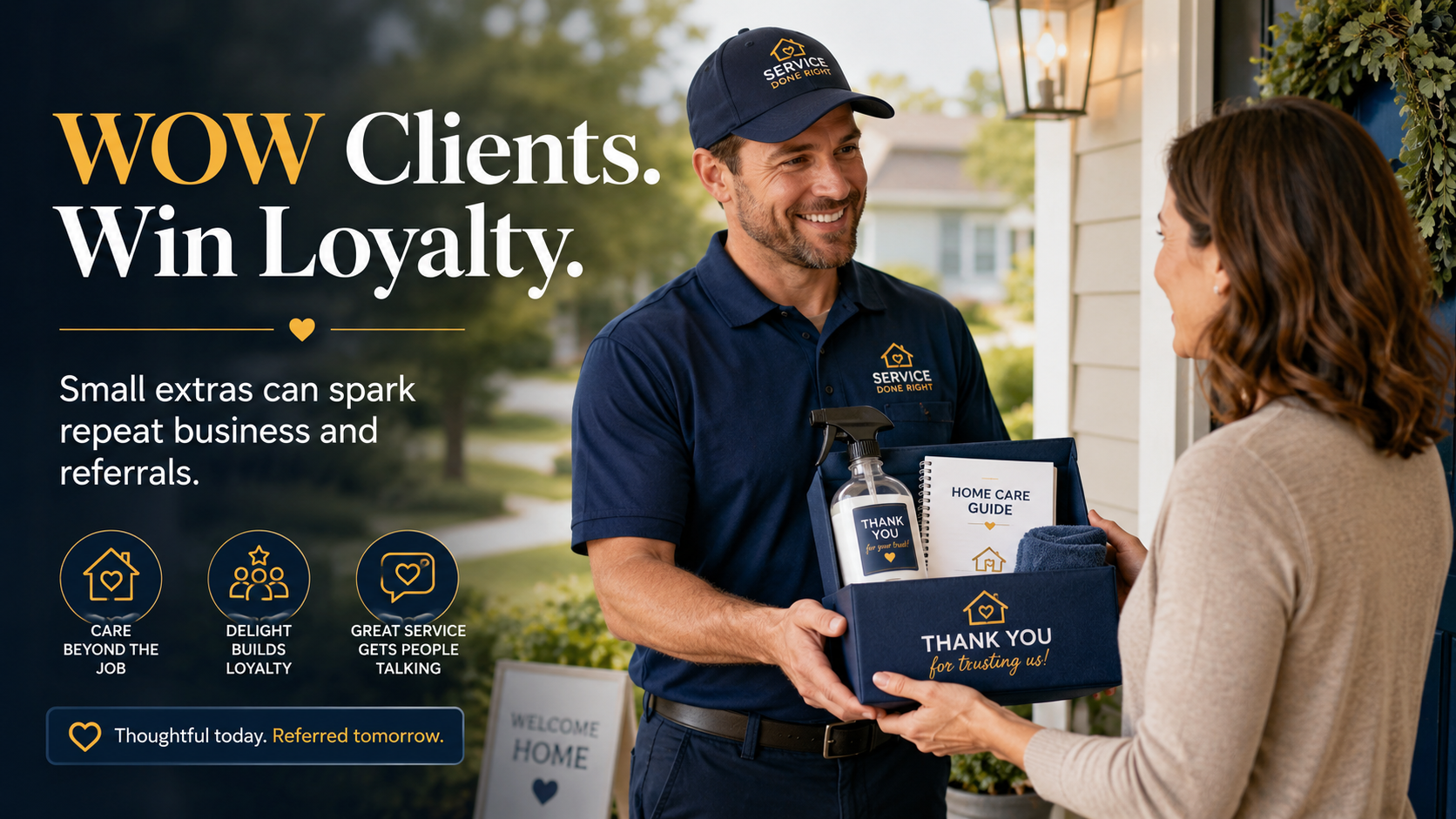
The real opportunity is to WOW the customer after the sale.
Now, before you start clutching your wallet like I just suggested you personally finance a parade, let’s make this very clear. WOW does not have to mean expensive. It does not mean hiring a brass band, releasing doves, or sending the customer a fruit basket so large it requires a forklift to deliver. In many cases, WOW is cheap. Embarrassingly cheap. Laughably cheap. Cheaper than the lunch you had sitting alone in a fast-food parking lot eating fries from the bag.
The magic is not in the price of the thing.
The magic is in the meaning of the thing.
Consider the carpet cleaner who gives every first-time client a free bottle of spot remover. Nothing glamorous. Nothing that would make Wall Street tremble. Just a useful bottle with his company label on it. He tells the customer it is the only spotter they will ever need, and if they ever run out, he will refill it for free.
Forever.
Now, the accountant in the corner, wearing bifocals and the emotional warmth of a parking meter, may immediately say, “But that costs money.” Yes. Congratulations. You have discovered commerce. Things cost money. But the real question is not what it costs. The real question is what it does.
That little bottle does several things at once.
First, it gives the customer a useful tool they can actually use. That matters. Customers do not need another refrigerator magnet shaped like a house, another pen that dies during tax season. They need something that helps them.
Second, it puts the business owner’s name right where the problem happens. When the dog has an accident, the child spills grape juice, or Uncle Larry drops barbecue sauce like he was raised in a barn, the customer reaches for the spotter. And there is the company name. Right in the customer’s hand. At the exact moment the customer is thinking about the problem that service solves.
That is not a giveaway.
That is a tiny salesman in a bottle.
Third, the free refill promise creates a feeling far bigger than the cost. Do customers line up around the block demanding free refills until the poor cleaner is ruined by his own generosity? No. Of course not. Hardly anyone will use the refill offer. But they remember that it exists. They remember the attitude behind it. They remember being treated as someone worth keeping.
This is the part service businesses keep missing: the offer is not only about redemption. It is about perception.
The promise itself changes how the customer feels. It says, “I am not here for one quick job. I plan to be your person for this problem from now on.” That is powerful. It creates ownership in the customer’s mind. It makes the service provider feel permanent.
Then this same carpet cleaner adds another simple item: a memo board for the refrigerator with his name, number, and carpet maintenance tips. Again, not expensive. Again, not fancy. But now his contact information is not buried in an email inbox, lost in a text thread, or written on a business card that died a lonely death in the junk drawer next to dead batteries and expired coupons.
It is on the refrigerator.
The customer sees it. The family sees it. Guests may see it. The business becomes part of the household environment. It sits there quietly, doing its job, reminding the customer who to call before the need arises.
That is smart marketing.
Not flashy. Not trendy. But smart.
And smart beats fashionable all day long.
Now let’s bring this into the wider service business world, because this is not just for carpet cleaners. This is for mobile detailers, pressure washers, house cleaners, pest control operators, lawn care companies, handyman services, HVAC techs, painters, mobile repair specialists, pet groomers, roof cleaners, window washers, and every other service provider who depends on repeat business and referrals.
The question is simple: What can you give your customer after the job that makes them feel unusually cared for and makes you harder to forget?
A pressure washing company could leave a small “home exterior care checklist” with seasonal reminders and the company’s phone number printed clearly on it. Not a boring brochure about how great the company is. Nobody cares. A useful checklist. Something the homeowner might keep.
A mobile detailer could leave behind a microfiber towel with care instructions and a small card explaining how to avoid swirl marks between appointments. That is not just a gift. That is positioning. It says, “I am the expert who protects your vehicle after I leave.”
A pest control company could provide a simple laminated “what to watch for” card listing signs of returning activity, with a clear instruction to call before the problem grows. That turns the customer into an alert partner and keeps the company top-of-mind.
A house cleaner could leave a small printed “quick rescue guide” for common spills, odors, and stains. Useful. Kept. Remembered.
A lawn care company could give customers a seasonal watering and mowing guide customized for the local climate. Suddenly, the company is not just the crew cutting grass. It becomes the advisor keeping the property healthy.
A handyman could leave a “small home repairs checklist” that helps homeowners spot little problems before they become expensive problems. Helpful to the customer. Profitable to the handyman. Beautifully sneaky in the best direct-response sense.
This is how you stop being a commodity.
Because here is the ugly little monster hiding under the service-business bed: when the customer cannot tell the difference between you and the next guy, price becomes the difference. That is when the race to the bottom begins. And the race to the bottom is crowded, sweaty, and full of people offering discounts they cannot afford.
WOW gives you another way out.
It gives the customer a story.
“I had this company come out, and after they finished, they gave me this little kit.”
“I hired this guy, and he left me a care guide.”
“The technician showed me exactly what to do if the problem comes back.”
“They even gave me this maintenance board so I know when to call.”
That is the sound of referrals being born.
Not because the customer was bribed. Not because you begged. Not because you chased them down with another generic “please leave us a review” message for doing exactly what they already expected you to do. It happens because the customer experienced something worth mentioning.
And that is the secret.
People talk about what interrupts the expected pattern.
Expected pattern: service provider shows up, does work, gets paid, leaves.
WOW pattern: service provider shows up, does work, gets paid, then leaves something useful, thoughtful, branded, and memorable behind.
That little difference can turn one job into repeat work. Repeat work into referrals. Referrals into lower acquisition cost. Lower acquisition cost into higher profit. Higher profit into the kind of calm business ownership where you are not checking your phone every eleven minutes watching Google Ads drain your bank account.
This is not fluff. This is math.
Let’s say your WOW item costs five dollars. Maybe ten. Maybe less. A printed guide, a labeled bottle, a small tool, a magnetized maintenance checklist, a laminated card, a microfiber cloth, a sample product, or a simple customer care kit. The amateur sees five dollars leaving. The marketer sees five dollars working.
That five dollars may create a second appointment. It may create a referral. It may keep the customer from calling your competitor. It may sit in the home for months, quietly reminding the customer of you. It may make your price feel more justified because the customer now sees you as more organized, more thoughtful, and more professional than the guy who left only tire marks and an invoice.
This is why cheap-minded service owners stay trapped. They count the cost of the item but ignore the lifetime value of the customer.
They say, “I can’t afford to give that away.”
The better question is, “Can I afford to be forgotten?”
Because forgotten is more expensive.
Forgotten means buying the same customer again later. Forgotten means competing against cheaper strangers. Forgotten means the customer has no emotional reason to come back. Forgotten means you did the work, but you failed to plant the flag.
The smartest service providers understand that the job is not finished when the service is completed. The job is finished when the customer has been moved into the next stage of the relationship.
That might mean a care item. It might mean a printed guide. It might mean a follow-up note. It might mean a small customer welcome kit. It might mean a fridge board, a branded checklist, a refillable bottle, or a clever “what to do next” card. The form can change. The principle does not.
You want the customer to feel three things after doing business with you.
First: “That was easy.”
Second: “That was better than I expected.”
Third: “I know exactly who I am calling next time.”
That third one is the money sentence.
Because the fortune in service businesses is not only in finding strangers. It is in converting first-time buyers into repeat customers, repeat customers into loyal customers, and loyal customers into walking, talking, unpaid salespeople who recommend you without being tackled in the driveway and handed a referral card.
WOW is not decoration. WOW is retention strategy.
It is customer reactivation before they go cold. It is referral generation before you ask. It is positioning before the competitor shows up. It is advertising placed inside the customer’s life instead of rented from a media platform that can change the rules before breakfast.
And the best part? The bar is low.
That is not an insult. That is an opportunity. In the service world, basic follow-up feels rare. Thoughtful extras feel shocking. Clear instructions feel luxurious. A useful leave-behind feels like someone actually had a plan.
You do not have to become legendary overnight. You just have to become more memorable than the forgettable parade of service providers who shuffle in, shuffle out, and leave nothing behind except a receipt.
So here is the practical challenge.
Before your next job, ask yourself: “What small, useful, branded item or piece of information can I leave with this customer that would help them, remind them of me, and make them feel smart for hiring me?”
Do not overthink it. Pick something useful. Put your name on it. Tie it to the problem you solve. Give it after the job. Explain why it matters. Make the customer feel cared for.
Then repeat it.
That is how small touches become systems. Systems create consistency. Consistency creates reputation. Reputation creates repeat business. Repeat business creates profit that does not require begging strangers to notice you.
And when your competitor is still running around shouting “free estimates” into the void, you will have something better.
A customer who remembers you.
A customer who trusts you.
A customer who knows who to call.
And maybe, best of all, a customer who tells someone else, “You should call my guy.”
That is the real WOW.
Not fireworks. Not gimmicks. Not circus tricks.
Just a small, smart, useful gesture that quietly says, “You made the right choice.”
And in a world full of lazy service, that little message can be worth a fortune.
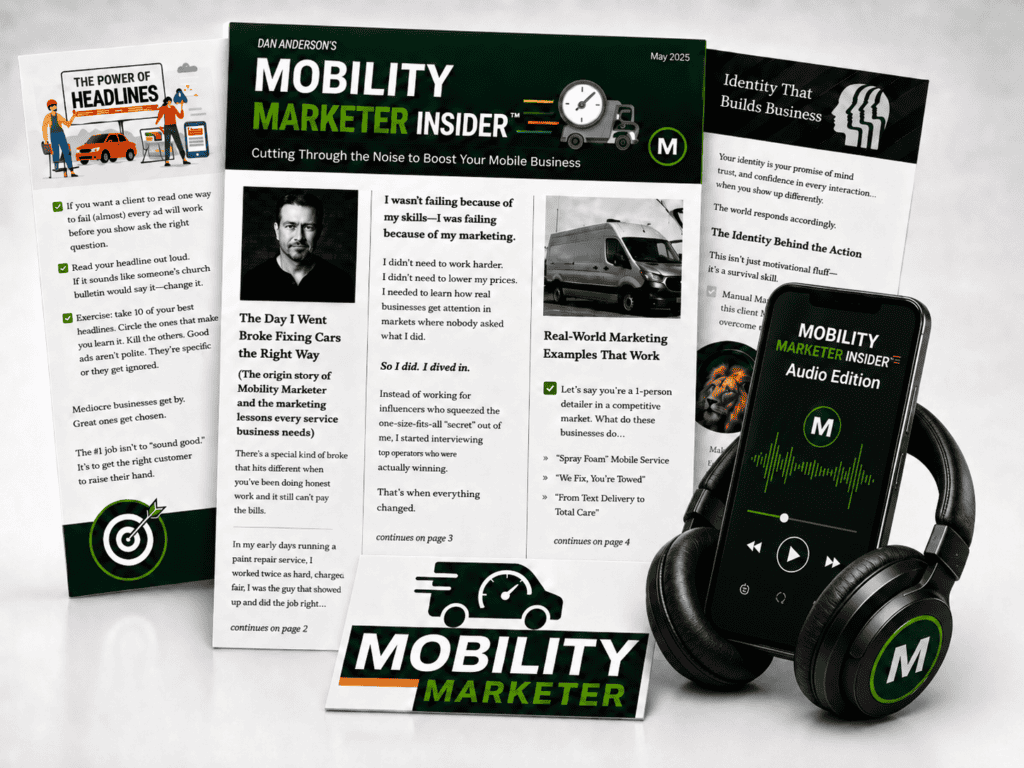
Get the Free Special Edition of Mobility Marketer Insider™
The article you just read is a perfect example of what separates a service business that gets remembered from one that gets quietly forgotten after the invoice is paid.
A customer care gift. A smart leave-behind. A simple follow-up piece. A useful reminder sitting on the refrigerator. These are not cute little extras. They are profit traps. They keep your name in the customer’s life after the job is done. They make repeat business easier. They make referrals more natural. They make your service feel more valuable without cutting your price like a panicked man holding a coupon book in a windstorm.
That is the kind of marketing thinking inside the Free Special Edition of Mobility Marketer Insider™.
Mobility Marketer Insider™ is written for service-based business owners who want more booked jobs, stronger follow-up, better customers, and a business that does not depend on random luck, cheap discounts, or the daily mood swings of Google and Facebook.
Inside the Free Special Edition, you will see how smart service businesses can use direct-response marketing to create stronger offers, turn one-time customers into repeat buyers, use simple follow-up systems, and build customer-getting habits that keep working after the first job is finished.
And because service business owners are busy, the Free Special Edition also includes a downloadable audio version.
That means you can listen while you work. Listen while you drive between jobs. Listen while you load the truck, clean equipment, handle paperwork, or sit in the driveway wondering how a five-dollar customer gift can quietly do more selling than another weak social media post.
This is practical marketing for people who actually work in the real world.
No theory circus. No fancy jargon. No pretending that a logo and a Facebook page are a marketing system.
Just useful, field-tested marketing ideas for service businesses that want to be remembered, rehired, and referred.
Get the Free Special Edition of Mobility Marketer Insider™, including the downloadable audio version, at:
mobilitymarketer.comRead it. Listen to it. Use it. Then start turning ordinary customer experiences into quiet little profit machines.