The Forgotten Marketing Weapon Sitting In Your Customer’s Mailbox
Posted on by Dan Anderson
How smart service business owners can use direct mail to reach better prospects, make stronger offers, and get customers without begging algorithms for permission.
There is a strange little box sitting outside your customer’s home. It does not need Wi-Fi. It does not care about Google’s latest mood swing. It does not hide your message behind a paywall, shadowban you, throttle your reach, or demand that you dance on video like a circus intern with a ring light.
It is called a mailbox.
And for the service business owner who knows how to use it, direct mail can still be one of the sharpest customer-getting tools available.
Not because it is old. Not because it is cute. Not because it gives you warm feelings about the good old days when people answered phones and children played outside without needing a charger.
Direct mail works because it is direct. It puts a physical sales message into the hands of a real person at a real address. No algorithm stands between you and the prospect. No social media platform gets to decide whether your customer is allowed to see your offer. No search engine auction forces you to compete with twelve companies who all claim to be “trusted, affordable, and professional,” which is business-owner code for “we sound exactly like everyone else, but please pick us anyway.”
A service business lives and dies by response. Calls. Bookings. Estimates. Appointments. Repeat work. Referrals. Jobs on the calendar. Cash in the bank. Not likes. Not views. Not “brand awareness.” You cannot deposit “awareness” at the bank unless your teller is heavily medicated.
Direct mail has one job: get the right person to take the right action now.
That is where too many service operators mess it up. They do not really send direct mail. They send paper noise.
They mail a flier with their logo at the top, a list of services in the middle, and a weak little coupon at the bottom. It usually says something like, “10% Off First Service,” as though the homeowner was sitting by the front door praying for a modest math problem.
That is not salesmanship. That is a printed shrug.
A good direct-mail piece does not simply announce that your company exists. It enters the reader’s life. It names a problem they already have. It gives that problem weight. It shows the cost of ignoring it. It offers a simple solution. It tells them what to do next. Then it gives them a reason to act before the piece disappears under school papers, grocery ads, and a pizza coupon that will live on the counter until the next presidential election.
Bad direct mail says, “Here is what we do.” Good direct mail says, “Here is the problem you want solved, and here is how to solve it before it gets worse.”
That difference matters.
A homeowner does not wake up excited to buy plumbing, pest control, landscaping, mobile paint repair, pressure washing, carpet cleaning, window cleaning, house cleaning, HVAC service, or handyman work. They wake up wanting peace. They want the leak gone. The bugs gone. The driveway clean. The yard handled. The scratch repaired. The house ready for guests. The smell removed. The room cooler. The broken thing fixed.
The service is only the vehicle. The desired result is what they buy.
That is why a service business should never mail a plain list of services and expect the phone to ring like a casino jackpot. People do not respond to lists. They respond to problems, fear, pride, deadlines, curiosity, convenience, embarrassment, relief, and opportunity.
A pressure washer should not lead with “We pressure wash homes, driveways, patios, and decks.” That is a service menu, not a reason to act.
A better message would be: “Before your driveway makes your whole house look older than it is, here is a simple way to clean up your curb appeal before the weekend.”
A mobile paint repair specialist should not lead with “We offer bumper repair and paint touch-up.” That sounds like everybody else with a van and a compressor.
A stronger message would be: “That bumper scratch may be hurting your car’s value every time someone sees it. Here is how to fix it without an insurance claim, a body shop visit, or losing your vehicle for days.”
A pest control company should not lead with “Safe, effective pest services.” That is wallpaper.
A stronger message would be: “The bugs you see are rarely the whole problem. Here is how to stop a small pest issue before it turns into an expensive invasion.”
That is direct-response thinking. It does not start with the business. It starts with the customer’s irritation.
The list is the silent killer or secret weapon of direct mail.
A great sales letter sent to the wrong people will fail. A decent sales letter sent to the right people can often survive. The list is not some boring back-office detail. It is the market. It decides whether your message lands in front of people with money, motive, and need—or people who would rather fix everything with duct tape, hope, and a YouTube video made by a guy in a shed.
A lawn care company should not blindly mail every address in a zip code. It should target neighborhoods where homeowners value appearance, have yards worth maintaining, and are likely to pay for convenience.
A house cleaning service should not mail the entire county. It should target busy professionals, higher-income neighborhoods, new movers, families with children, and homes where the value of saved time is obvious.
A mobile detailer should not mail randomly. It should target owners of higher-value vehicles, office parks, gated communities, and neighborhoods where people care how their car looks in the driveway.
A handyman should not send a generic flier to everyone. He should target older homes, absentee landlords, real estate agents, property managers, and homeowners likely to have a growing list of repairs they keep ignoring.
This is not complicated. But it does require thought. The lazy way is to buy “a zip code.” The profitable way is to ask, “Who is most likely to want this, value this, afford this, and act on this?”
That one question can save a pile of money.
Now let’s talk about the offer, because this is where direct mail either turns into a customer-getting machine or a very expensive way to decorate trash cans.
“Call for a free estimate” is not an irresistible offer. That is expected. It is like telling restaurant customers the fork is included.
A good offer has shape. It has a name. It has a clear benefit. It reduces risk. It gives a reason to respond.
A landscaper might offer a “7-Point Curb Appeal Checkup.”
A plumber might offer a “Leak Risk Inspection for Homes Over 15 Years Old.”
A cleaning service might offer a “Guest-Ready Home Cleaning Package.”
A pressure washer might offer a “Driveway Rescue Week.”
A mobile detailer might offer a “Before-You-Trade-It Vehicle Cleanup Special.”
A mobile repair service might offer a “Scratch & Scuff Value-Saver Inspection.”
Notice what these offers do. They do not merely discount. They create context. They give the prospect a reason to raise their hand. They turn the service into a specific result.
A discount can work, but a discount by itself is a weak crutch. It attracts price shoppers and trains people to wait for cheaper. A named offer tied to a problem is stronger because it sells value, not just a lower price.
Then comes the headline.
The headline is the bouncer at the door of the reader’s attention. It decides who gets in. A weak headline lets attention walk away.
“Quality Home Services You Can Trust” is not a headline. It is a nap.
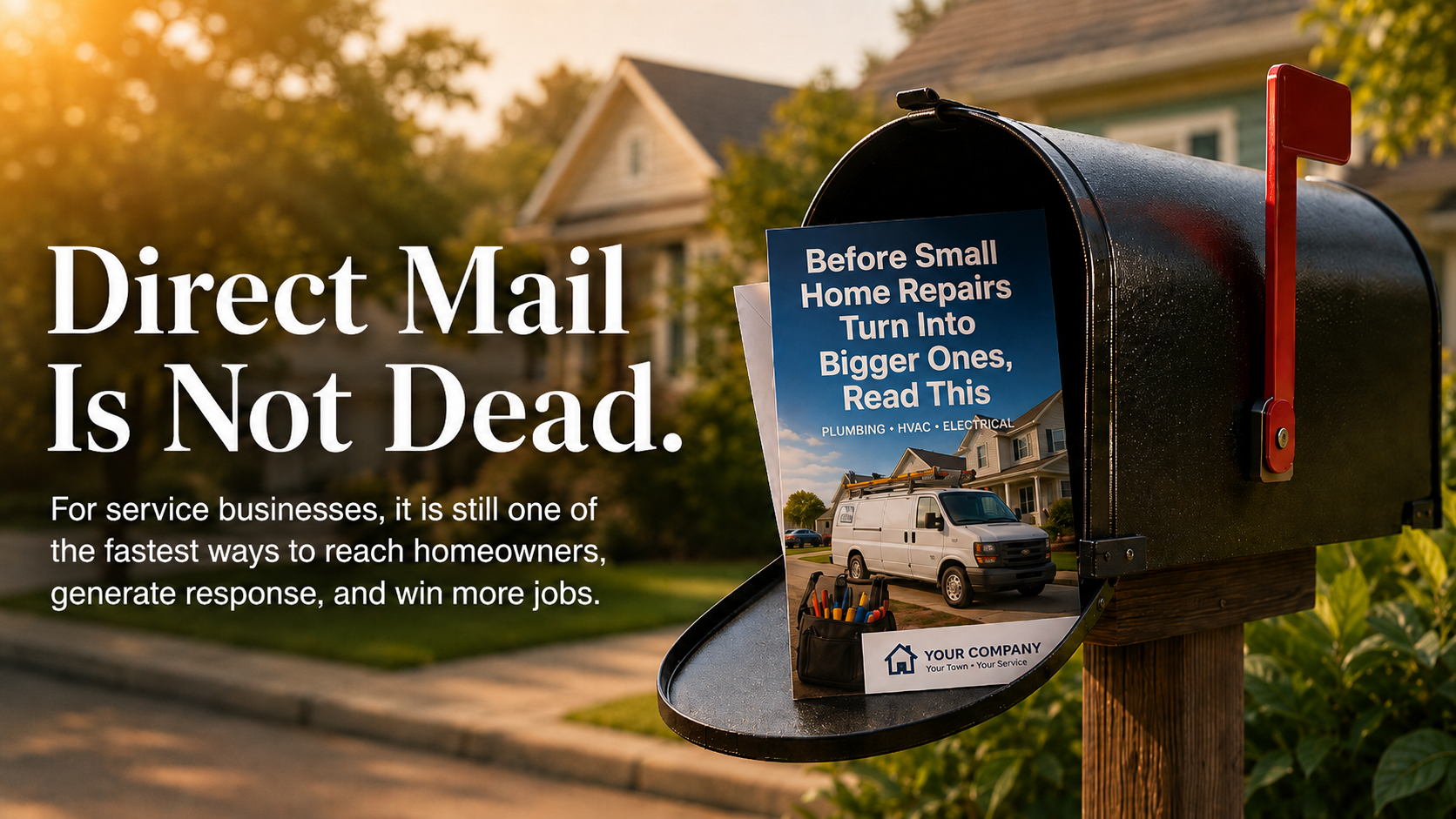
“Before Small Home Repairs Turn Into Bigger Ones, Read This” is a headline.
“Your Driveway May Be Making Your Home Look $10,000 Older” is a headline.
“Pet Odor, Dirty Grout, Dusty Baseboards, and The Lie We Tell Ourselves Before Guests Arrive” is a headline.
“3 Warning Signs Your AC May Be About To Quit During The Worst Possible Week” is a headline.
The headline should make the right reader feel personally interrupted. Not annoyed. Not tricked. Interrupted in the way a smoke alarm interrupts dinner. It should say, “This matters to you.”
After the headline, the letter needs to build interest. This is where the business owner must stop bragging and start diagnosing.
Talk about the customer’s problem in plain language. Describe what they see, smell, hear, feel, worry about, or keep putting off. Show that you understand their world. Then explain why the issue matters.
The stained driveway hurts curb appeal. The dirty windows make the house feel dull. The leaking faucet wastes money and may hide a bigger issue. The scratched bumper makes the vehicle look neglected. The overgrown yard makes the property look abandoned by adult supervision. The air conditioner making that strange sound may not be “fine.” It may be plotting revenge.
Once the reader feels understood, then you present the service as the solution.
Not before.
This is where desire comes in. Paint the after-picture. The home looks cared for. The car looks sharp again. The air feels comfortable. The yard looks handled. The bugs are gone. The repair is off the mental to-do list. The customer can stop thinking about the problem.
That is what service businesses really sell: relief.
Then tell them exactly what to do.
Do not mumble. Do not say, “Reach out with any questions.” That is weak. Give clear instructions.
“Call by Friday at 5:00 p.m. to claim one of this week’s appointment openings.”
“Text CLEAN to request the Guest-Ready Home Package.”
“Scan the code to schedule your free 7-Point Curb Appeal Checkup.”
“Reply before Wednesday to get on the neighborhood route.”
Clear orders create response. Vague invitations create silence.
Finally, use a real deadline.
A deadline is not decoration. It is the fuse. Without a deadline, the reader delays. Delay becomes forgetting. Forgetting becomes lost money.
The deadline can be based on limited route days, seasonal timing, a bonus, appointment availability, neighborhood scheduling, or a special inspection window. It must be believable. It must be real. And it must be clear.
For example: “We are scheduling two service days in your neighborhood next week. Respond by Friday to reserve one of the available spots.”
That gives the reader a reason to act now without sounding like a carnival barker selling miracle soap from the back of a wagon.
The service business owner who understands direct mail has an advantage. While competitors are all fighting in the same crowded online spaces, he can quietly reach the exact homes, neighborhoods, customers, and prospects he wants. He can test offers. Track calls. Follow up. Mail again. Build routes. Revive past customers. Create repeat business. Fill slow weeks.
Direct mail is not dead.
Lazy mail is dead. Generic mail is dead. Service-list mail is dead. “Here’s 10% off because we didn’t know what else to say” mail is dead.
But a strong letter, sent to the right list, with a sharp headline, a real offer, clear action, and a deadline is alive and dangerous.
Your customer’s mailbox is still open.
The only question is whether you are going to put a salesman in it—or another forgettable flier wearing a coupon hat.
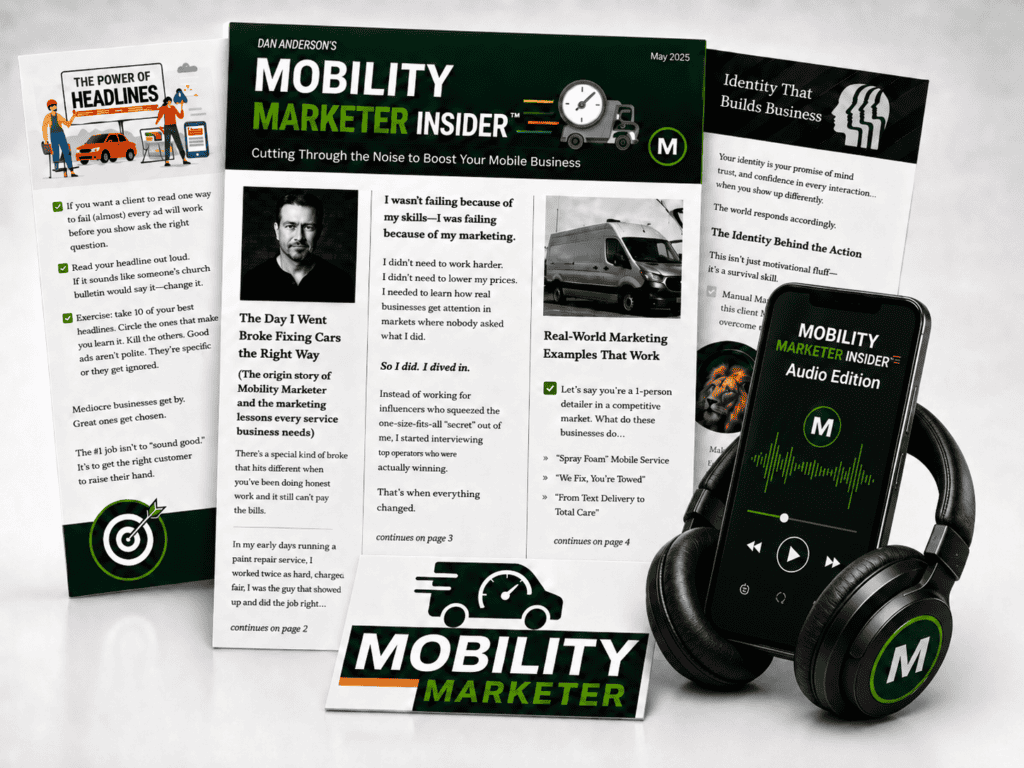
Get the Free Special Edition of Mobility Marketer Insider™
Getting more customers should not feel like begging Google, posting into the void, or waiting for the phone to ring like it owes you money.
That is why I created Mobility Marketer Insider™ — a practical marketing newsletter for service-based business owners who want more jobs, better customers, stronger follow-up, and less dependence on random luck.
The Free Special Edition shows how service businesses can use direct-response marketing to create stronger offers, follow up better, win more repeat work, and stop treating every job like a one-time accident. It is written for people in the field — mobile detailers, carpet cleaners, pressure washers, painters, handymen, cleaners, lawn care operators, repair techs, and local service businesses that need booked jobs, not empty attention.
And because you are busy, there is also a downloadable audio version. You can listen while driving between jobs, loading the truck, cleaning equipment, or handling the daily chaos that comes with running a service business.
That is the idea behind Listen While You Work.
Get the Free Special Edition of Mobility Marketer Insider™, including the downloadable audio version, at:
Read it. Listen to it. Use it to start thinking like a marketer instead of a tired technician waiting for the next random phone call.