Stop Inventing From Scratch: The Smart Service Owner’s Guide to Modeling Marketing Ideas
Posted on by Dan Anderson
Originality is overrated. The money usually goes to the service business owner who knows what to study, what to borrow, what to adapt, and what to deploy before his competitors finish staring at the blank screen.
Have you contracted the disease running loose in service businesses.
It is called “I need a completely original idea.”
Symptoms include staring at a blank screen, changing your website headline 43 times, buying another marketing course, and eventually posting something so limp it looks like it needs a vitamin shot.
Originality is overrated.
Profit is not.
The smartest service owner does not sit around waiting for a lightning bolt from the heavens to strike his forehead and whisper, “Here, my son, is the perfect campaign.” He watches. He collects. He studies. He borrows structure. He adapts proven ideas. He sees what works in one business and asks the magic question:
How can I apply this to my business?
That question may be worth more than your next equipment upgrade.
There is a difference between stealing and modeling. Stealing is lazy, dumb, and usually done by people who think changing three words makes them clever. Modeling is different. Modeling means you study the underlying idea, understand why it works, and rebuild it honestly for your own market.
A carpet cleaner should not copy another carpet cleaner’s ad word for word. That is not marketing. That is wearing another man’s pants and hoping nobody notices.
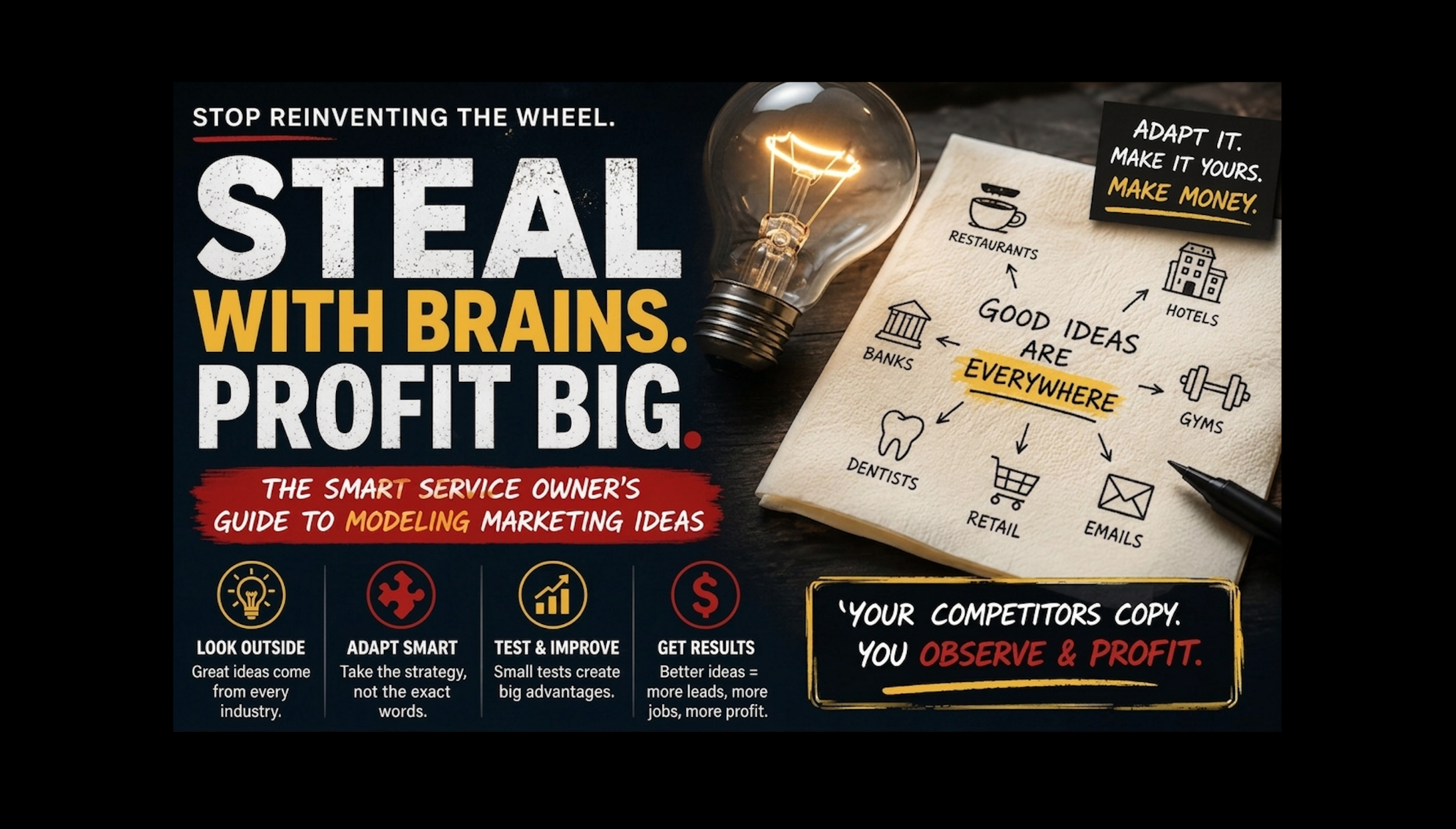
But a carpet cleaner can study a restaurant promotion, a hotel loyalty program, a dentist’s reactivation letter, a car wash membership offer, a gym referral campaign, or a pest control reminder system and ask, “What is the mechanism here?”
That is where the money hides.
The fast-food drive-thru did not drop from the sky wearing a paper crown. The idea was borrowed from banks. Somebody looked at a bank drive-thru and realized customers liked convenience without getting out of the car. Then somebody applied that convenience to burgers, fries, and drinks. America gained a new way to eat lunch while making questionable driving decisions.
That is modeling.
Not copying the bank. Not pretending a hamburger is a checking account. Taking the idea behind the idea and moving it into a new context.
That is not copying. That is learning.
Great marketing ideas are everywhere if you stop walking around half-asleep.
The trouble is that service owners are often so busy doing the work that they stop noticing the world. They stand in line at a coffee shop and never study the loyalty card. They get a dentist reminder and never ask how it could become a customer reactivation message. They receive a hotel rewards email and never think about creating a preferred customer list.
The world is handing out marketing lessons all day long. The average owner walks past them like they are invisible furniture.
That is expensive.
Here is a simple habit: create a marketing swipe file.
Not a digital junk drawer where good ideas go to die under screenshots of old coupons and one mysterious PDF named “final-final-new-version.” Create a real swipe file. Save ads, emails, postcards, headlines, offers, referral cards, appointment reminders, sales pages, thank-you notes, welcome packets, and anything that gets your attention.
Do not only save pieces from your own industry. In fact, some of the best ideas will come from outside your industry because competitors are usually staring at each other like nervous squirrels in matching uniforms.
Watch businesses that are good at getting repeat purchases: hotels, restaurants, dentists, chiropractors, car washes, gyms, lawn care companies, insurance agents, charities, catalog companies, and smart retailers.
Then ask better questions.
What is the hook? What is the offer? What makes me want to respond now? What risk are they removing? What proof are they using? What emotion are they touching? What behavior are they encouraging?
The question “Do I like this?” is almost useless. Your taste is not the cash register. The better question is, “What is this trying to make me do, and how is it doing it?”
That is how a service owner becomes dangerous.
A carpet cleaner might model a restaurant’s “limited seating” concept by offering a “first five spring cleaning appointments” notice to past customers. A window washer might model a gym’s membership continuity by offering quarterly exterior glass care. A mobile detailer might model hotel rewards by creating a preferred client priority list.
You do not need a giant breakthrough. You need usable ideas.
One borrowed mechanism, properly adapted, can outperform a dozen original guesses.
Start with your customer list. Ask what other businesses do to bring customers back. Then build a simple version. It may be a private past-customer offer, a referral reward, a reminder campaign, a checklist, a seasonal audit, a bonus upgrade, or a “first access” appointment window.
Next, look at your lead generation. Ask what businesses outside your industry offer in exchange for attention. Free guides. Quizzes. Scorecards. Checklists. Price calculators. Buyer’s guides. Maintenance tips. Mistake reports. Then turn one into your own lead magnet.
A carpet cleaner could offer “The Homeowner’s 7-Point Carpet Rescue Checklist.” A pressure washer could offer “The Dirty Driveway Warning List.” A mobile detailer could offer “The Before-You-Sell Vehicle Clean-Up Checklist.” Each one gives a prospect a reason to raise his hand without feeling like he is being tackled by a salesman in a cheap polo.
Then look at your follow-up. This is where money quietly escapes through the back door wearing soft shoes. Model businesses that follow up intelligently. Appointment reminders. Renewal notices. “Still interested?” messages. “You asked about this” messages. “Here is what happens next” messages.
A lead who does not book today is not dead. He is undecided. Unclear. Distracted. Comparing. Waiting. Forgetful. Busy. Maybe cheap. Maybe not. But if you do not follow up, you will never know. You are donating him back to the marketplace for no good reason.
The point is not to become a copycat.
The point is to become observant.
Every business you interact with is either teaching you what to do or what to avoid. Bad ads teach. Good ads teach. Confusing emails teach. Brilliant offers teach. Annoying customer processes teach. Smooth customer processes teach.
The service owner who studies these lessons gains an unfair advantage over the owner who only looks at competitors and says, “Well, everybody seems to be doing it this way.”
That sentence should be buried behind every broke marketing plan.
Everybody doing it does not make it smart. It often means the herd is walking toward the same cliff, congratulating each other on brand consistency.
So this week, do something simple. Collect five marketing ideas from outside your industry. Write down the mechanism behind each one. Then choose one to adapt into your business.
Not someday. Not after the busy season. This week.
Find one proven idea. Adapt it. Test it. Track it.
Because the best marketing idea for your service business may not come from another service business at all. It may come from a hotel, a bank, a pizza shop, a dentist, or a weird little postcard sitting in your mailbox looking innocent.
Keep your eyes open.
The money likes to hide in plain sight.
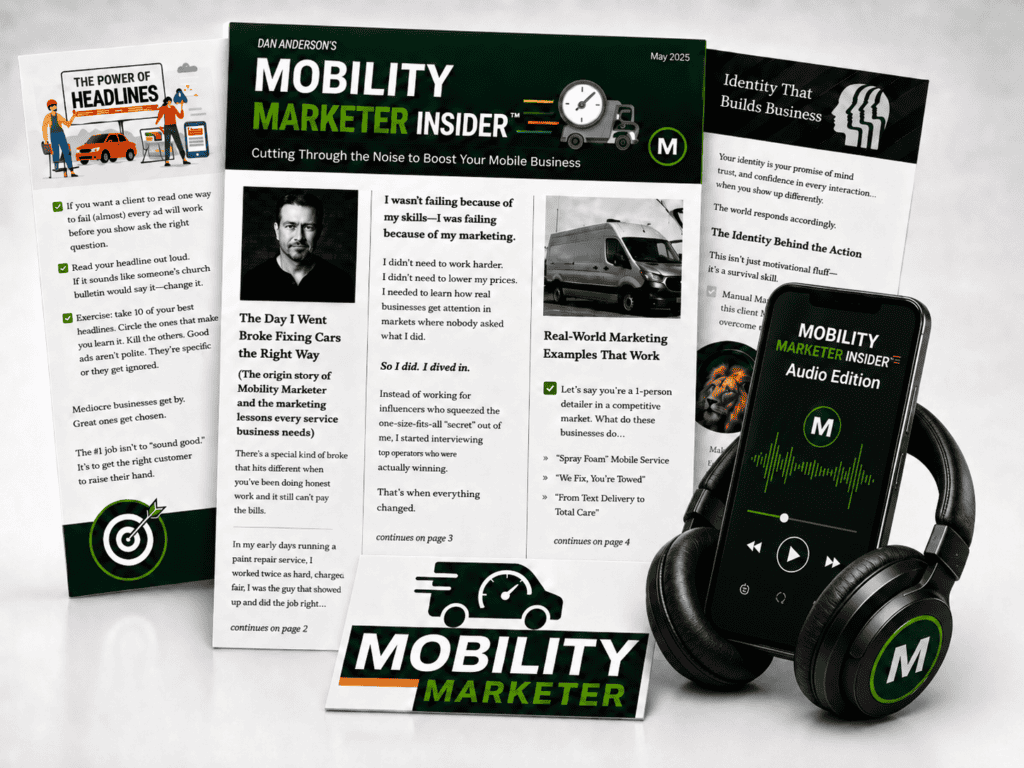
Get the Free Special Edition of Mobility Marketer Insider™
For more practical, field-tested marketing ideas for mobile service business owners, grab the free special edition of Mobility Marketer Insider™ at:
mobilitymarketer.comInside, you'll discover proven customer acquisition strategies, follow-up systems that help turn more leads into paying jobs, referral tactics that generate word-of-mouth business, and retention ideas designed to increase repeat bookings without constantly chasing new customers.
You'll also get real-world examples you can adapt to your own business, saving you time, reducing costly trial and error, and helping you market more effectively with the resources you already have.
Download your free copy today and start putting proven ideas to work that can help you attract better customers, book more jobs, and grow revenue with less guesswork.